Methods & sources
A reading is only worth trusting if you can see how it was made. This page names our sources, how the scoring works, what we do with your words — and where the limits are.
The idea
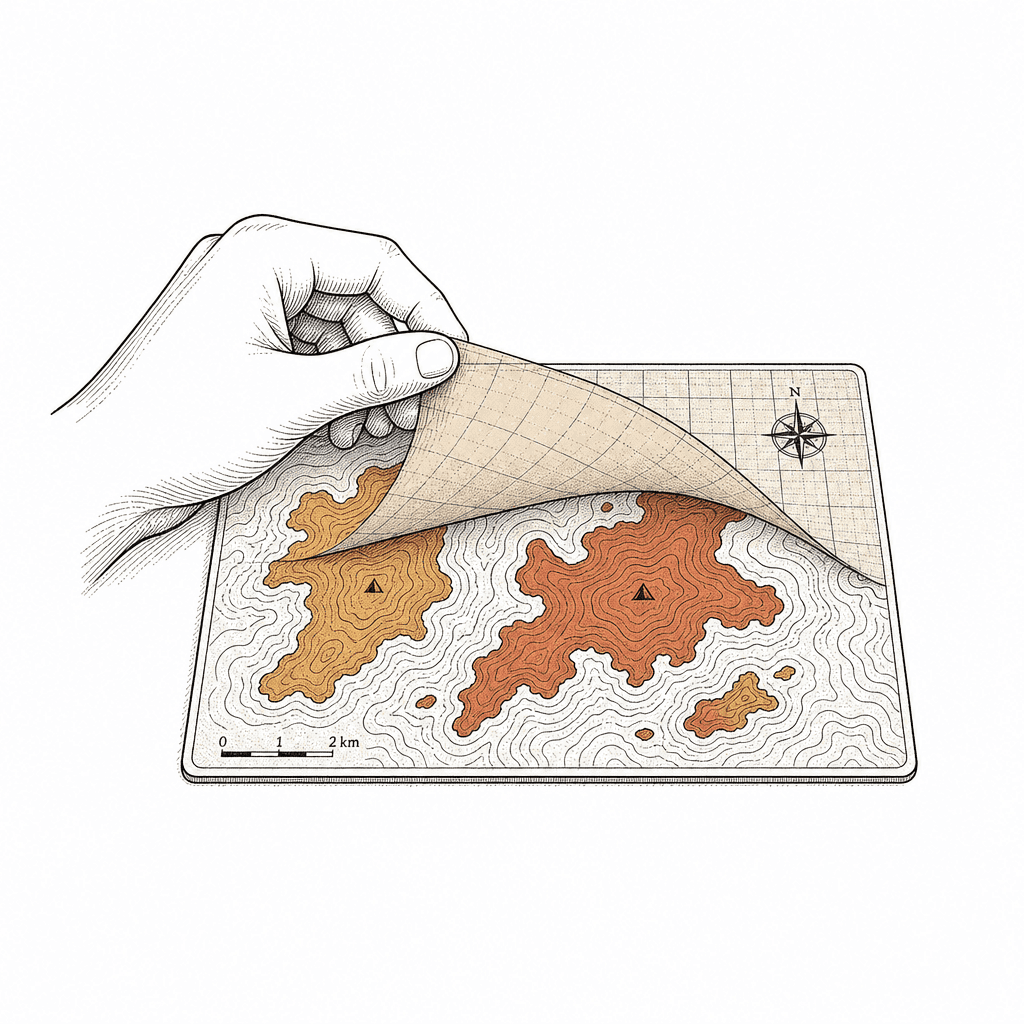
Every reading maps two layers of one person. The first is the baseline: how your energy, decisions, and sensitivities are naturally wired. The second is the learned layer: the habits life trained on top of that wiring — ways of saying yes, working, and keeping the peace that were picked up to stay safe or approved of.
Most advice fails because it treats those layers as one thing. The reading lives in the gap between them: where the life you're running fits your wiring, and where it pinches.
Layer one
The baseline layer is Human Design–inspired. We calculate your chart with our own astronomical ephemeris from your birth date, time, and place — the same calculation every time, no guessing.
We are transparent about what that is: Human Design is a modern synthesis, not science. We treat the chart as a structured mirror for self-reflection — a precise vocabulary for noticing how you work, each piece testable against your own weeks.
Layer two
The learned layer draws on real psychological research, used reflectively. The conditioning archetypes are informed by attachment theory — the study of how early bonds shape adult patterns of closeness and distance. The stress material is informed by stress-response research: the fight, flight, freeze, and fawn responses.
The 'life that fits' frame is informed by self-determination theory and research on self-concordant goals — goals aligned with a person's authentic interests and values, which that research links to wellbeing and follow-through. The energy material is informed by research on burnout — the exhaustion that builds when effort runs against the grain for too long.
All of it is used reflectively: the reading describes patterns in plain language so you can check them against your own weeks. The one line we hold is that none of it is administered as a clinical instrument — no diagnostic questionnaires, no scoring against norms.
The instrument
Six areas of life — Energy, Decision, Boundary, Visibility, Worth, Belonging — are each scored 0 to 100 from your quiz answers. Every answer carries small weights toward the areas it touches; the weights sum into a pressure reading per area.
The Readout reads pressure, not character: a snapshot of your last few months, and retaking the quiz after a season of change would move it. A low score marks where life currently pinches; that is where your reading goes deepest.
Your words
At the end of the quiz you can add a sentence or two about what's going on in your life. It is optional, and it is used for exactly one thing: writing your reading — quoted back to you where it belongs, so the book answers the life you actually described.
Before any use, an automated pass removes links, other people's full names, and anything that shouldn't be repeated. Your note never feeds analytics, advertising, or anything outside your own book.
The writing
Your chart and your answers are composed into one manuscript by a writing system we built for exactly this: it must ground every claim in your specific chart and answers, it is forbidden from inventing facts, medical claims, or predictions, and its output is checked against a content rulebook before the book ships.
That is our stance in an age of generated advice: pro-personalization, not anti-AI. We use computation to make the one thing mass tools can't — a reading with a sample size of one. The enemy is generic, not technology.
The limits
Pattern Atlas is for reflection and personal development. It is not therapy, not diagnosis, not medical, mental-health, legal, or financial advice, and not a prediction of anything. If something in a reading doesn't ring true, trust your own experience over the page — the reading is a mirror, not a sentence.
We also keep the promises small on purpose: no fake scarcity, no invented statistics, no 'the universe wants'. A reading gives you precise language for how you work and small, reversible experiments to test it. What you do with that stays entirely yours.

Questions
Partly, and we're precise about which part. The psychology layer is informed by real research — attachment theory, stress-response research, self-determination theory — used reflectively, not administered as clinical instruments. The chart layer is Human Design–inspired, which is a modern synthesis, not science. We never stamp a reading 'proven', and we won't pretend otherwise.
No — and it isn't a horoscope. Your chart is calculated from your exact birth data with an astronomical ephemeris, and it describes how you're wired, not what will happen to you. There are no predictions anywhere in a reading.
Judge it by its inputs and its rules. The reading is composed from your chart and your answers only, by a system that is forbidden from inventing facts, diagnoses, or predictions, and checked against a content rulebook before it ships. The point of using computation is personalization: a book that could not exist for anyone else.
No. It reads the current pressure in six areas of your life from your own answers — a snapshot that would move if your season changed. It doesn't type you or compare you to anyone.
Never. The reading maps fit and pressure — where your life fits your wiring, where it pinches, and what loosens it. It offers hypotheses to check against your own experience, not verdicts.
They are used to calculate your chart and write your reading — that's it. The optional note you write is cleaned automatically and appears only inside your own book. Nothing is sold, and nothing feeds advertising.
Pattern Atlas is for reflection and personal development. It is not medical, mental health, legal, financial, or relationship advice.
Six minutes of questions. A book about exactly one person.
Start my readingNot ready? Get your free chart first