human design conditioning
Human Design Conditioning: When Life Runs on 'I Should'
What Human Design conditioning means, how to tell an 'I should' rule from a real limit, and one small experiment to try in your own life.

human design conditioning
What Human Design conditioning means, how to tell an 'I should' rule from a real limit, and one small experiment to try in your own life.
Human Design calls it conditioning when people take on other people's pace, pressure, and expectations. You can explore that idea through one ordinary choice: what do you want, what do you think you should do, and what does life actually require? Keeping those questions separate makes room for a smaller, more useful change.
Within Human Design, your birth chart describes how you were born to work: how your energy runs and how you decide best. Conditioning is the system's term for the influences you pick up along the way. Its teaching asks where those influences have become rules you live by without checking whether they fit.
Jovian Archive's explanation of conditioning connects it with the pressure to meet outside expectations. It uses the term not-self for choices driven by that pressure. You can consider the idea through a familiar sentence: "I should say yes, even though I wanted that evening to myself."
Human Design is a symbolic system, not established science. A chart cannot tell us who taught someone a habit or why they learned it. Those are claims about a person's life, and a birth calculation cannot supply that history.
What it can offer is a question worth checking. Think of a specific moment: a request arriving, a meeting running late, or a weekend filling up. What did you want before you began deciding what would be acceptable to everyone else?
Centers are the nine shapes in a Human Design chart, each linked to a theme such as decisions, work, or communication. Human Design teaches that colored centers describe consistency, while white centers are more open to outside influence. It connects conditioning especially with those white areas.
The terminology has one useful distinction. A white center is undefined because no complete channel, a connection between two centers, defines it. A completely open center also has no activated gates, the numbered points within it. "Open" is often used loosely for both. Jovian Archive explains the distinction.
Here are three examples from Human Design's teaching, translated into questions you can check against your days:
| White center | Theme in Human Design | A question for an ordinary moment |
|---|---|---|
| Heart, also called Ego | Pressure to prove your worth | Am I taking this on because it matters to me, or to show I can handle it? |
| Solar Plexus | Avoiding a difficult exchange | What would I like to say, and is there a safe way to say it? |
| Sacral | Keeping up with other people's activity | What is a workable stopping point for this task today? |
These themes come from Jovian Archive's account of the not-self. The questions are our practical prompts. A white shape alone does not tell us whether any of them applies to you. For help finding the shapes, our guide to reading a Human Design chart walks through the layout.
Start with one recent choice and write three separate sentences: what you wanted, what you felt expected to do, and what the situation required. The answers may overlap. The useful part is seeing the reasons clearly enough to decide which ones you still agree with and where you have room to act.
Take a Saturday invitation. "I want to see my friend" is one answer. "I should stay all day so nobody thinks I don't care" is another. "The last bus leaves at six" is a practical limit. All three can be true at the same time. They deserve different responses.
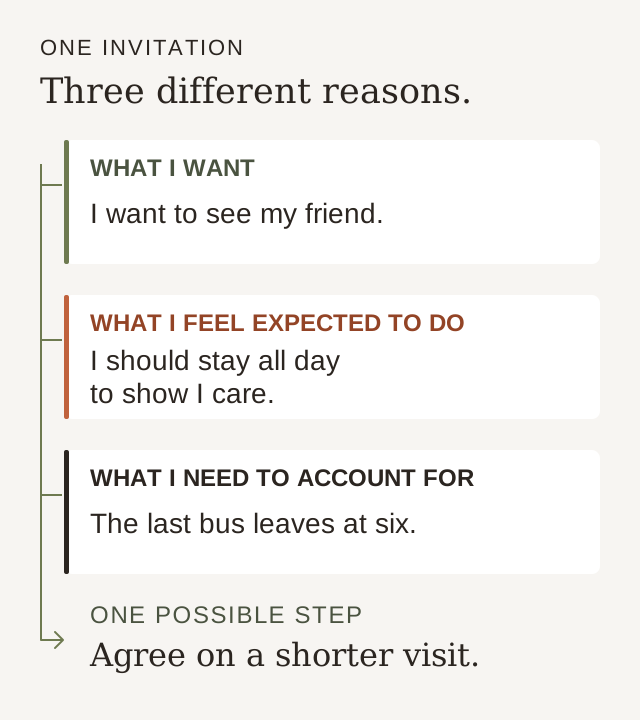
Try asking, "If nobody praised or criticized this choice, what would still matter to me?" Then bring the other people and the practical facts back into the picture. This question helps you name a preference. It does not erase the relationships or responsibilities involved.
An "I should" sentence can also express a value you choose. You might want to keep a promise, share the work fairly, or visit someone you love even when the journey is tiring. You can agree with an expectation after examining it. You do not have to reject it to make the choice your own.
If the same rule appears in several parts of your week, write down where it shows up. Keep the wording specific: "I agree before checking my time" gives you something to notice next time. A broad label gives you much less to work with.
Money, care, health, time, and safety are real limits. They belong in any useful plan. A choice can feel difficult because the available options are narrow. Before treating a thought as an expectation to challenge, ask what would actually happen if you acted differently, and what support you would need.
"I need this shift to cover the rent" names a material need. "I should always volunteer first so people know I'm committed" names a rule worth examining. Both might be present in the same decision. You can question the second while keeping the first fully in view.
Someone caring for a relative may have little control over their evenings. A useful step might be finding out whether another person can cover one task. If that help is unavailable, the care still needs doing. Calling the whole situation conditioning would miss what they are dealing with.
If speaking up could put your safety or livelihood at risk, observation may be the available step for now. Write down what you would prefer and what would need to change before you could try it. That is a valid place to pause.
It might look like changing when you answer a request. In this fictional example, Alex enjoys helping colleagues and wants to keep doing it. What needs attention is the quick agreement to optional extra work, before checking the tasks already due. A small pause gives Alex time to check what will fit.
On Tuesday, a colleague asks Alex to review a presentation that afternoon. Alex says yes, then realizes that two existing deadlines already fill the day. The thought Alex notices is, "A helpful person should be available."
Here is the situation in three sentences:
There is no need to decide where the rule came from. The next optional request provides a chance to try something different:
"Let me check today's work. I can give you an answer after lunch."
Alex may still say yes. They may offer to review two slides tomorrow, or explain that the work needs another person. The experiment is checking before committing. Its value is in whether it helps Alex make a promise they can keep.
If Alex's chart has an undefined Heart center, Human Design's theme of proving worth could be a question to consider. The evidence for this particular situation is what Alex noticed and reported. The chart supplies neither the colleague's motives nor an explanation of Alex's past.
Human Design calls the practice of loosening the grip of outside pressure deconditioning. A manageable place to begin is one small choice you can try differently. Name the occasion, the action, and what you will do if the action is unavailable. Then review what happened after a week.
In the traditional teaching, this practice involves Strategy, the approach to engaging with opportunities associated with a type, and Authority, the system's guidance for making decisions. Jovian Archive describes this as an ongoing experiment, with a seven-year horizon. That is Human Design teaching, not a tested timetable for personal change. Read its account of deconditioning.
You can make the everyday step concrete with an if-then plan: decide in advance what you will do when a particular situation occurs. A review by Sheeran, Listrom, and Gollwitzer examined 642 independent tests of this kind of planning. It found benefits across a range of outcomes, with larger effects when plans used an if-then format and were rehearsed. This research supports the planning tool; it does not test Human Design or this specific exercise. See the research review.
For Alex, the plan becomes:
If a colleague asks me to take on optional work, then I will check my current tasks before agreeing.
The fallback could be: "If an answer is needed now, I will ask which existing task should move." Try the words aloud once so they are easier to use in the moment.
After a week, ask:
If it helped, keep it. If it did not, adjust the step or set it aside. The exercise has done its job when it gives you clearer information about your actual week.
Your experience wins. If a chart theme does not fit, leave it aside and work with what you can observe. You do not have to find hidden pressure, invent a problem, or turn a satisfying part of life into something that needs changing. Understanding what already works is useful too.
For example, a white Heart center does not mean every commitment involves proving something. You might enjoy the work, have plenty of time, and feel good about saying yes. That answer deserves to stand.
Birth-time uncertainty also matters. Some chart details may change across the possible birth window. Check whether a center stays the same before making it part of your reflection. You can use the three sentences above while that remains unsettled; they begin with a situation you know.
If life already fits, ask what helps it stay that way. Perhaps your team agrees on priorities, or your friends welcome shorter visits. Those are arrangements worth recognizing and protecting.
Pattern Atlas uses your Human Design chart alongside your answers about everyday life. The chart offers the system's account of how you were born to work. Your answers describe how you live now. A personal reading brings them together, with one small step that fits what you have actually reported.
The free quiz leads to a free summary: your situation in your own words, your chart in plain language, and the two side by side. It also shows your book's contents and page one. The complete paid reading is a PDF book, with practical tools, words you can use, six worksheets, and one experiment to try. The specific step and its fallback belong in the book.
The reading is built from carefully written passages, chosen for your answers. It credits Human Design's teaching to Human Design, keeps real limits in view, and makes room for a life that already works. Our methods and sources explain how the parts fit together.
You can start your own reflection with one recent choice and three sentences: "I wanted…", "I felt I should…", and "I needed to account for…". Seeing those reasons clearly may be enough to find one small thing you want to try next.
Human Design calls it conditioning when people pick up other people's pace, pressure, and expectations. The system connects this especially with the white, undefined centers in a birth chart. It offers a way to reflect on everyday choices; your own experience decides whether a theme fits.
Both appear white in a Human Design chart. An undefined center has no complete channel defining it. A completely open center also has no activated gates, the numbered points within it. People often use 'open' for both in everyday explanations. Neither tells us what a person has actually experienced.
Human Design commonly describes a seven-year process. That is the system's teaching, not a tested timetable for personal change. For the small exercise here, check what happened after a week: was the step possible, did it help, and is it worth keeping? You do not need to reach a state of being completely deconditioned.
Yes. You can look at what you want, what you feel expected to do, and what your circumstances require without a chart. An uncertain birth time can leave chart details unsettled. Pattern Atlas checks which details stay the same across the possible birth window and makes uncertainty clear.
Pattern Atlas is a Human Design–inspired reflective self-discovery product, not a diagnostic tool.
Keep reading

August 17, 2026 · 4 min read
A life audit is a structured check of where your life fits how you're actually wired versus where it's running on autopilot. What it looks like, how often to do one, and a six-area method to run your own.

August 14, 2026 · 4 min read
Which Human Design book to start with, what each one actually covers, and how to read them without treating the system as more certain than it is.

August 10, 2026 · 6 min read
A plain-language guide to Human Design coaches: what a session involves, the 70/30 rule, what to look for, and how to tell whether you need a coach or just your chart.
Curious about your own chart?
Compute your free Human Design chart — your energy type and full bodygraph, in under a minute. No account needed.