human design profiles
Human Design Profiles: How to Read Your Two Numbers
Understand all 12 Human Design profiles, what the two numbers mean, and how to turn their themes into useful questions about learning and everyday life.
human design profiles
Understand all 12 Human Design profiles, what the two numbers mean, and how to turn their themes into useful questions about learning and everyday life.
A Human Design profile is a pair of numbers, such as 1/3 or 2/4, used to describe themes in learning and relationships. There are twelve profiles, made from six numbered lines. Read each number in its given order, then explore how the two themes meet in situations you recognize from your own life.
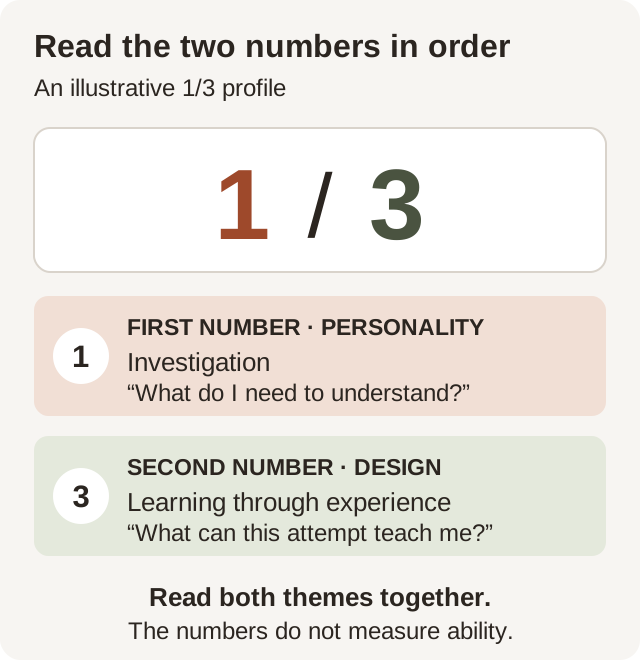
The first number belongs to the Personality side of the chart, which Human Design links to qualities you recognize consciously. The second belongs to the Design side, which it links to patterns you may notice less readily. The order matters: the pair combines two positions, each with its own meaning in the system.
Personality and Design are Human Design terms. In a traditional chart, the Personality entries appear in black and the Design entries in red. Jovian Archive explains those two sides. They provide the background for reading the first and second numbers.
Take 1/3 as an example. Its first number points to line 1, associated with investigating and building a foundation. Its second points to line 3, associated with learning through attempts and adjustments. We will look at all six lines below.
Human Design is a symbolic system, not a scientifically validated personality assessment. Its profile descriptions offer ideas to explore. Your actual experience determines which ideas are useful to you.
Look for a field labeled "Profile" beside your chart or in its summary. It should show a pair such as 3/5 or 6/2. Copy both numbers in the order given. They come from the birth-chart calculation; you do not choose a profile by picking the description you like best.
For readers interested in the calculation, Human Design takes the line values associated with the Sun and Earth on the Personality and Design sides. The first profile number comes from Personality, the second from Design. Jovian Archive's introduction to profile describes this relationship.
A line is one of six numbered subdivisions used in the chart system. Here, it names a theme. It is different from the connecting strokes you see between shapes in the chart.
If two calculators give different profiles, compare the birth date, time, and place entered in each. If the time is uncertain, keep that uncertainty visible. Pattern Atlas includes profile in a reading only when the result stays settled across the possible birth window.
Our guide to Human Design without a birth time explains that check. A settled type does not automatically settle the profile too.
Human Design gives each line a traditional name and a set of themes. You may see words such as Investigator, Hermit, or Martyr in a reading. The table below translates those names into plain language and offers one question for each. Use the questions to look at a real situation before deciding what fits.
The names and broad themes come from Jovian Archive's explanation of the six lines. The reflection questions are our own practical prompts.
| Line and traditional name | Theme in Human Design | A question to explore |
|---|---|---|
| 1 — Investigator | Research and a secure foundation | What information would help me take the next step? |
| 2 — Hermit | Natural ability, solitude, and being called out | What do I enjoy doing quietly, and when do I want to share it? |
| 3 — Martyr | Learning through trial and error | What did this attempt teach me that I can use next time? |
| 4 — Opportunist | Friendship, trust, and connection | Which existing relationship would I like to give time to? |
| 5 — Heretic | Practical solutions and others' expectations | What help can I actually offer, and what are people assuming? |
| 6 — Role Model | Experience, perspective, and example | What have I learned that I now put into practice? |
Some of the names can sound heavier than the idea they describe. "Martyr," for example, is the system's name for the third line's trial and error theme. It does not ask you to seek suffering or stay with something harmful. "Hermit" does not require you to withdraw from people you value.
Human Design describes the sixth line through stages of trying, observing, and living what has been learned. You can explore that theme without treating a birthday as a deadline for becoming wise or having your life arranged a certain way.
The twelve profiles are the particular pairs listed below. Each brings together two line themes in a set order. Find your pair, read its themes, and follow the link if you want a fuller description. The short phrases are a starting point for reflection, with room for differences between people who share the same numbers.
| Profile | Themes to read together |
|---|---|
| 1/3 | Investigation and learning through experience |
| 1/4 | Investigation and trusted connections |
| 2/4 | Private talent and trusted connections |
| 2/5 | Private talent and expectations to help |
| 3/5 | Learning through experience and practical solutions |
| 3/6 | Experimenting and developing perspective |
| 4/6 | Trusted connections and leading by example |
| 4/1 | Trusted connections and a foundation of knowledge |
| 5/1 | Practical solutions and investigation |
| 5/2 | Expectations to help and private talent |
| 6/2 | Developing perspective and private talent |
| 6/3 | Developing perspective and ongoing experimentation |
Jovian Archive's profile overview sets out these twelve combinations. You may encounter different titles for the same pair across websites. Start with the numbers when comparing descriptions.
For example, the themes of 1/4 and 4/1 include both investigation and connection. Their order gives them different positions in the system. Neither pair is a higher level of the other.
The familiar question "Which profile is best?" has no ranking to refer to here. The numbers describe categories within Human Design. They do not establish who is more capable, mature, or likely to succeed.
Type, authority, and profile describe different things within Human Design. Type gives a broad account of how you engage with life. Authority is the system's guidance for decisions. Profile adds themes about learning and relating to others. Reading one field does not tell you everything recorded in the other two.
You might see all three together in a summary. A chart can name Generator as the type, emotional authority as the decision guidance, and 1/3 as the profile. That is one combination of three separate details.
Our guide to the five types introduces the type names. For a practical look at one decision theme, the article on sacral authority explains what a concrete yes-or-no question can help you notice.
A profile does not replace those fields or supply missing birth information. Knowing that you relate to the third line's learning theme does not confirm your type or authority.
It also leaves many ordinary differences untouched. Two people with a 1/3 profile can have different skills, jobs, interests, and ways of learning a particular task. One might want a written recipe; another might find a short demonstration more useful. The number pair cannot tell you which happened in either person's kitchen.
Keep the mismatch visible and look at a specific example. A general description may fit one part of your life, fit poorly, or offer nothing useful today. You can check the chart inputs while keeping your own account of what happened. An unfamiliar description does not establish that something is wrong with you.
Suppose a profile description talks about enjoying solitude, while you usually prefer company. You might notice that you like being alone for one particular activity. Or you might find no useful connection at all. Both are possible outcomes of looking honestly.
The word "unconscious" needs care here. It is part of Human Design's account of the second number. It should not become a way to dismiss your disagreement: "You cannot see it, so that proves it is true."
If you ask someone close to you for their view, ask for an example. "When have you seen me learn something by trying it?" gives you more to discuss than "Am I really a third-line person?" Their recollection is another perspective, and you can compare it with your own.
You can also recognize a theme from another profile. Enjoying research does not require a 1 in your pair. A description can give you a useful question without becoming a new identity or changing your calculated chart.
Choose one theme, turn it into a question about something small, and compare it with what you already know about yourself. Then try one practical adjustment if it fits your time and circumstances. Keep a note of what helped and what did not. You do not need to act out every part of the description.
Consider this fictional example. Ravi has a 1/3 profile and wants to mend a shirt. He likes having clear instructions. He also notices that watching several more videos has not helped him start the repair.
He takes the investigation and experimentation themes as two questions: "What do I still need to know?" and "What can I learn by trying a little?"
He reads one set of instructions, then practices a few stitches on spare fabric before working on the shirt. He has ten minutes available, so that is the whole attempt for today.
| What to note | Ravi's example |
|---|---|
| The situation | "I keep looking up how to mend this seam." |
| The question | "What would a small practice attempt show me?" |
| What happened | "Trying the stitch helped me see where I was pulling too tightly." |
| What to keep | "Next time, I want instructions beside me while I practice." |
The useful information is specific: having instructions nearby helped Ravi practice. One repair cannot show that every 1/3 learns this way, or that Ravi will prefer this approach for every task.
Your own attempt could produce a different result. You might discover that you want a demonstration, a friend's help, or more time. Those findings give you something to work with.
Money, care responsibilities, health, and available time stay part of the picture. A theme about solitude does not create a free evening. A theme about helping others does not make you responsible for every request. Choose an adjustment that fits the life you have.
Profile supplies one set of Human Design themes within a personal reading. Your answers supply the details of your current life. Pattern Atlas brings those sources together, keeping profile only when it is settled in the birth-time check. The purpose is to find one small step that makes sense in your actual circumstances.
Human Design describes how you were born to work. Your quiz answers describe how you live now, including expectations, your own "I should" rules, and practical limits. The reading puts those accounts side by side. Where they disagree, your experience takes priority.
The free summary introduces that story and shows your book's contents and page one. The complete reading is a PDF book built from carefully written passages, chosen for your answers. It follows one situation through to a small step, with practical tools and words you can use. The methods page explains how the chart and your answers each contribute.
For now, pick one question from your profile's themes and connect it to a real example from this week. Keep the details of that example beside the description. They give you a way to decide what is useful enough to try again.
Human Design has 12 profiles: 1/3, 1/4, 2/4, 2/5, 3/5, 3/6, 4/6, 4/1, 5/1, 5/2, 6/2, and 6/3. They are specific pairings of six line numbers. The numbers name themes in the system; they are not scores or ranks.
The first number comes from the Personality side of the chart, which Human Design associates with conscious qualities. The second comes from the Design side, which it associates with less conscious patterns. Read the pair in the order shown on the chart, and compare the interpretation with what you actually notice.
No. Type is the system's broad account of how you engage with life. Profile combines themes about learning and relating to others. Authority is another field, describing the system's approach to decisions. People with the same type can have different profiles.
The birth-chart calculation gives the same profile when the birth inputs and calculation are unchanged. Correcting a birth time may change the result. Your interests, skills, circumstances, and response to the description can also change without changing the profile recorded on that chart.
Keep that observation. Check that the birth details and profile numbers were entered correctly, then compare the description with specific examples from your life. You can find a question useful while rejecting a claim that does not fit. An unfamiliar description does not prove that you have a hidden problem.
Pattern Atlas is a Human Design–inspired reflective self-discovery product, not a diagnostic tool.
Keep reading
November 4, 2026 · 10 min read
What does 'wait for the invitation' mean for a Human Design Projector? Explore recognition, sharing your work, and deciding which invitations fit your life.
October 21, 2026 · 10 min read
Explore sacral authority in Human Design with clear yes-or-no questions, examples of unclear responses, and a way to check what a commitment actually involves.
October 14, 2026 · 10 min read
Don't know your exact birth time? Learn which Human Design details may stay the same, how time checks work, and what to do when two types remain possible.
Curious about your own chart?
Compute your free Human Design chart — your energy type and full bodygraph, in under a minute. No account needed.