human design chart without birth time
Human Design Without a Birth Time: What Stays the Same?
Don't know your exact birth time? Learn which Human Design details may stay the same, how time checks work, and what to do when two types remain possible.
human design chart without birth time
Don't know your exact birth time? Learn which Human Design details may stay the same, how time checks work, and what to do when two types remain possible.
You can explore Human Design without an exact birth time, but it helps to separate what stays the same from what depends on the clock. A birth-time check compares possible results across the time you might have been born. Keep the details that remain settled, name the uncertainty, and leave room for better information.
Human Design uses your birth details to calculate a chart. Different times can produce different chart details, including the type, the system's broad description of how you engage with life. The effect depends on what changes within the particular time window. An uncertain time does not make every part equally uncertain.
Jovian Archive's birth-time guidance notes that even a small difference can change parts of a chart. That makes the useful question specific: what changes around the time you might have been born?
The chart's shapes are called centers. Connections between them are channels, made from pairs of numbered points called gates. Human Design builds its descriptions from these relationships. A change in the underlying pattern may affect one detail while leaving another intact. Jovian Archive explains the chart structure.
Human Design is a symbolic system, not established science. Here, accuracy means getting the chart calculation right for the birth information available. It does not turn the interpretation into a measured fact about your personality, needs, or future.
You can take the input seriously while keeping your own judgment about what the reading says.
Enter the closest description of what you actually know, and mark the uncertainty. An estimate such as "around eight" contains less information than a recorded time. If you only know the date and place, choose the unknown-time option. Adding invented minutes can make the result look more precise than the evidence allows.
Pattern Atlas asks how well you know your birth time before asking for the time itself. You can choose exact, within about fifteen minutes, within about an hour, roughly, or unknown. If you choose unknown, you do not need to supply a clock time.
| What you know | How to approach the entry | What to keep in mind |
|---|---|---|
| A specific time from a record you trust | Enter that time and check the date and place | Keep a note of the source in case you revisit it |
| An estimate such as "around eight" | Enter the estimate with an honest uncertainty setting | A remembered round hour does not establish the exact minute |
| Only a broad part of the day | Mark it as rough, or unknown if you cannot give a useful estimate | Keep the wider uncertainty visible |
| The date and place, with no time | Choose unknown where the tool supports it | A single noon chart cannot show the whole day's possibilities |
Using noon as a placeholder gives you the answer to "What would the chart be at noon?" It does not answer "Which details are safe to carry forward without the time?" A comparison across the possible window answers that second question more directly.
If a tool only accepts an exact time, label the resulting chart as a provisional example. You can return to it when you have more information.
A birth-time check compares chart results across the possible window and looks at each detail separately. Type might stay the same while another detail varies. The result should tell you which findings were unchanged in the check and which depend on a time you have not yet confirmed.
Authority is Human Design's guidance for making decisions. Profile is its two-number description of a person's role and way of learning. These are separate chart details. A settled type does not automatically settle either of them.
Here is a simplified illustration of that distinction. It represents an imaginary comparison, not a calculation for a particular birth date:
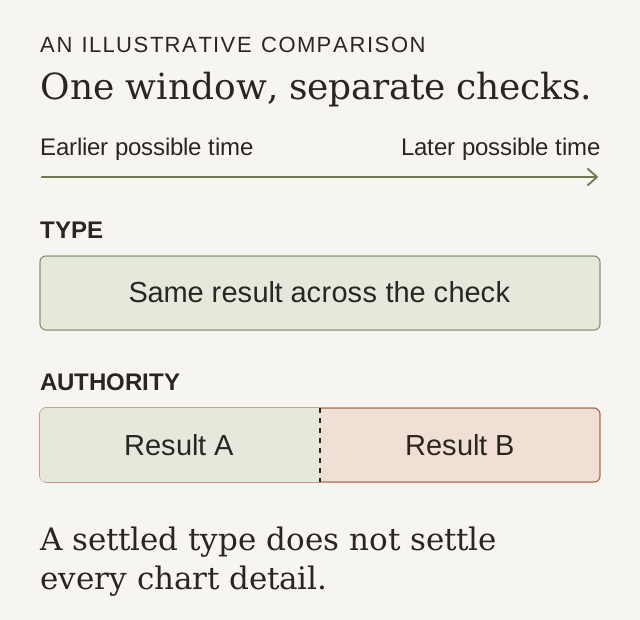
Pattern Atlas compares chart values across the window indicated by your answer. With an unknown time, it checks across the birth day. With a rough time, it checks around the estimate. It carries authority and profile into the reading only when those details are settled in the check.
The same care applies to an open center, a white shape that Human Design associates with outside influence. It only becomes part of the reading's story when its status is settled. Our article on Human Design conditioning explains that teaching and how to compare it with everyday experience.
This comparison cannot recover a missing birth record. It tells you how much the available chart information depends on the time still missing.
Some chart tools call a type "most likely" when it covers most of the possible birth window. It is still a guess. The label comes from the time comparison, not from how closely a personality description seems to fit.
Pattern Atlas does not guess. Without a birth time, your reading leaves the chart out and works from your answers until you add one.
The length of a time window is not a recovered fact about when you were born. If a record later puts your birth in the shorter window, the type for that time is the relevant calculation. "Most likely" leaves room for that correction.
It also tells you nothing about whether you are "more" one kind of person than another. Type names belong to Human Design's chart system. They are not measures of how much energy, insight, or ambition someone has.
If two types remain possible, you can learn what they share and keep their differences open. You do not need to choose a permanent label before reflecting on your life. Our plain-language guide to the five types introduces the names and the ideas associated with them.
A description can help you notice something useful without identifying the time you were born. Recognizing yourself in one account gives you information about your response to that account. It does not establish which clock time belongs in a birth record. Keep those two kinds of information separate as you explore.
Consider this fictional example. Sam has two possible chart results and reads both descriptions. One mentions working best with room to pause. Sam thinks of a recent afternoon when a short gap between meetings helped them prepare for the next conversation.
That is a specific observation Sam can use. They might try leaving a similar gap next week, if the calendar allows. It still does not identify which of the possible birth times is correct.
Sam can write two separate notes: "The time is still uncertain" and "A gap between meetings helped on Tuesday." Both notes can remain true. There is no need to settle the first before learning from the second.
This is also why Pattern Atlas uses quiz answers alongside the chart. What you report supplies the personal facts. A birth calculation cannot supply the details of your workload, relationships, or available time.
Begin with a record that might contain the time, such as your birth certificate or a record held by the place where you were born. You can also ask someone who was present what they remember. Keep track of where each answer came from and whether it was written down or recalled.
Jovian Archive suggests checking a birth certificate or contacting the hospital. Before requesting a document, ask whether that particular record includes a time. That can save you a request that produces only the date you already know.
A simple note is enough:
If two sources disagree, keep both rather than quietly choosing the one that gives the chart you prefer. You can ask the record holder for help understanding the entry, or keep a wider range while the discrepancy is unresolved.
There may be no accessible record or person to ask. In that case, you can continue with the uncertainty stated. Finding the exact minute does not have to become another task you feel you must complete before anything else can be useful.
First compare the inputs: the same birth date, clock time, place, and uncertainty setting. A date entered in a different format or an AM/PM mix-up can change the result. Then check whether you are comparing one chart for one time with a summary of several possible times. Those outputs answer different questions.
The myBodyGraph help page on differing charts specifically recommends checking date order and time format. "04/10" can mean April 10 or October 4, depending on the form. Reading back the month name makes that ambiguity easier to catch.
Place matters because of time zones. myBodyGraph explains that birthplace is used to identify the correct time zone. Use the place where you were born, and follow the calculator's instructions for the clock time it expects. Avoid manually converting the time unless the form asks for a converted value.
Also check the wording beside the result. A single-time chart may display a type plainly. A tool checking a wider window may display that same type as provisional. The difference in confidence is worth understanding before assuming the calculations disagree.
If identical inputs still produce conflicting results, ask the provider to explain the calculation and assumptions. You can leave the disputed detail open while using the rest of the information available.
A personal reading can work with the chart information available and the life you describe now. Pattern Atlas keeps uncertainty visible while bringing those two sources together. The useful question is what the reading can honestly say from your answers and chart, and what it needs to leave open.
Human Design describes how you were born to work. Your quiz answers describe how you live now, including other people's expectations, your own "I should" rules, and practical limits. You may recognize a difference between the two, or find that this part of life already fits.
The free summary places your situation beside your chart in plain words once you give your birth time. Without it, the summary leaves the chart out. You can see the contents and page one of your book before deciding whether to buy the complete reading.
The paid reading is a PDF book built from carefully written passages, chosen for your answers. It carries the story through to one small step, with practical tools and words you can use. Your real limits remain part of the plan. Our methods and sources explain how the chart and your answers each contribute.
For now, write down the birth information you have, where it came from, and what is still uncertain. That gives you an honest starting point. You can keep what is useful today and revisit the chart when better information becomes available.
You can explore the possible charts for your birth date and place. A birth-time check compares results across a window and shows which details stay the same in that check. Some details may remain uncertain. A chart calculated at an invented time should be treated as one possible result.
Noon produces the chart for noon. It does not establish your actual birth time or show whether other times would give a different answer. Use an unknown-time option when available. If a tool requires a time, label any placeholder clearly and keep its results provisional.
They can if the interval crosses a chart change that affects type. In another interval, the type may stay the same. A small change can also affect a finer detail while leaving type unchanged. The useful question is what changes around your own possible time, rather than whether one margin works for everyone.
Recognizing yourself in a description does not verify a birth time. You can use a helpful question from that description while keeping the chart result uncertain. A birth record and a personal reflection answer different questions.
Yes. An unknown birth time does not prevent an adult who completes the quiz from getting a reading. Without a birth time, the free summary and the book leave the chart out rather than guess, and work from your answers about everyday life. Add your birth time later, and they explain your chart.
Pattern Atlas is a Human Design–inspired reflective self-discovery product, not a diagnostic tool.
Keep reading
November 4, 2026 · 10 min read
What does 'wait for the invitation' mean for a Human Design Projector? Explore recognition, sharing your work, and deciding which invitations fit your life.
October 28, 2026 · 10 min read
Understand all 12 Human Design profiles, what the two numbers mean, and how to turn their themes into useful questions about learning and everyday life.
October 21, 2026 · 10 min read
Explore sacral authority in Human Design with clear yes-or-no questions, examples of unclear responses, and a way to check what a commitment actually involves.
Curious about your own chart?
Compute your free Human Design chart — your energy type and full bodygraph, in under a minute. No account needed.