projector waiting for invitation
Projector Invitations: What Does Waiting Actually Mean?
What does 'wait for the invitation' mean for a Human Design Projector? Explore recognition, sharing your work, and deciding which invitations fit your life.

projector waiting for invitation
What does 'wait for the invitation' mean for a Human Design Projector? Explore recognition, sharing your work, and deciding which invitations fit your life.
In Human Design, "wait for the invitation" means that a Projector's contribution is recognized and welcomed before a major commitment. An invitation still leaves a choice. You can explore this teaching by noticing who wants your input, what they are asking for, and whether the opportunity fits the life you actually have.
Human Design calls Projector one of its types and describes its role as offering focused insight and guidance. Its strategy, the system's approach to entering commitments, is to wait for recognition and an invitation. The teaching places particular emphasis on major areas of life, such as work, relationships, and living arrangements.
Jovian Archive's Projector introduction sets out this strategy. It also distinguishes receiving an invitation from deciding to accept one. Our Projector reference introduces the type in plain language.
Human Design is a symbolic framework, not a scientifically validated account of your abilities or future. Here, we use its invitation theme to explore an ordinary question: is your contribution wanted in this particular situation?
That question becomes concrete when a friend describes a problem. You may see a possible solution immediately. The missing information is whether they want suggestions, practical help, or someone to listen. You can find that out before offering a detailed plan.
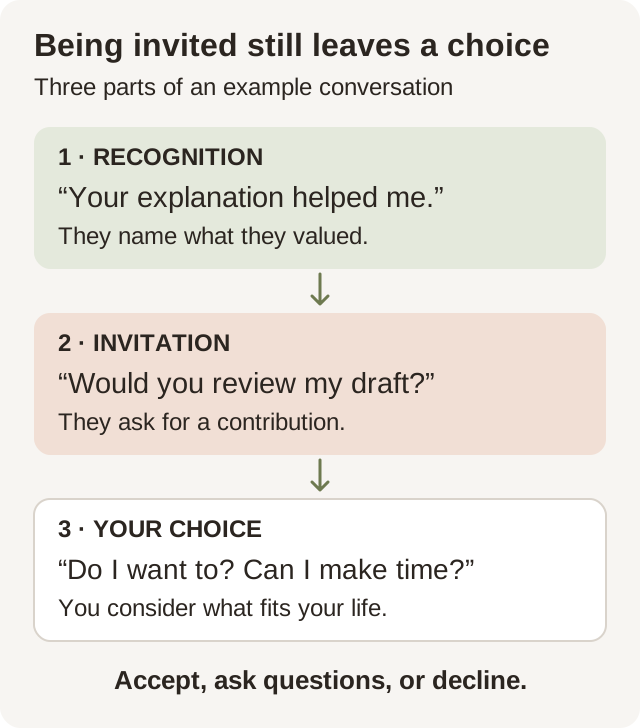
Recognition names something someone values about your contribution. An invitation asks you to bring it into a particular situation. A compliment can be pleasant without containing a request, while a request can leave important details unclear. Listening for both gives you a better picture of what the other person actually wants from you.
In its discussion of Projectors, recognition, and invitations, Jovian Archive emphasizes recognition of a particular contribution and a clear role. You can examine those ideas through the words someone uses, without needing to guess their hidden intentions.
| What someone says | What you know so far | A useful next question |
|---|---|---|
| "You're great at explaining things." | They are offering appreciation | No reply beyond thanks is required |
| "Your example helped me understand the process." | They have named a specific contribution | Is there anything further they want to discuss? |
| "Would you help me explain this to the group?" | They are asking for your input | What does the group need to understand? |
| "We should work together sometime." | They have expressed interest | What kind of work do they have in mind? |
These are conversation examples, not tests of whether a person or offer is good. A vague opening may become a thoughtful request after one question. A warm compliment can remain a warm compliment.
You also do not owe extra work in exchange for being appreciated. "Thank you, I'm glad that helped" is a complete response when there is nothing else you want to take on.
You can apply for work, show what you make, study, and tell people what interests you. Those actions let others understand what you can offer. Exploring the invitation theme can help you assess the response you receive. It does not require putting ordinary needs or existing responsibilities on hold while someone notices you.
Jovian Archive explicitly distinguishes waiting from passivity in its account of the Projector strategy. Our practical approach is to make your work understandable and leave room for other people to choose whether they want to engage with it.
For example, you could share a piece of work with a short explanation of the problem it addresses. You could tell a colleague which part of a project you would like to contribute to. You could ask about an available role and learn what the team needs.
Each action opens a conversation. None obliges the other person to offer a role, and none obliges you to accept one.
If you need paid work, that need is part of the situation. A chart description does not pay a bill or remove a deadline. You can pursue available options and consider their actual conditions, including hours, pay, care responsibilities, and the work being requested.
There is also no promise that becoming more visible will bring the opportunity you want. A lack of response gives you limited information about that attempt. It does not measure your worth or the quality of everything you have to offer.
Separate being recognized, receiving a request, and making your own decision. Someone can value your contribution while offering a role you do not want or cannot take on. Understand the request, consider your interest and practical limits, and give yourself room to answer. An invitation begins that process; it does not finish it.
Authority is Human Design's guidance for decisions. Projectors do not all have the same authority. The chart's details matter within the system, as Jovian Archive's overview of Projector variations explains. An invitation alone does not replace that part of the teaching.
In practical terms, find out what is being offered. Who wants your input? What would you be responsible for? How much time is involved? Can you influence the part you are being asked to help with?
Then include your own answer. You may want the conversation but lack the time this week. You may like the work while finding that the conditions do not fit. You can ask a question, discuss an adjustment, accept, or decline.
Words you can use include: "I'm interested. Before I answer, could you tell me what you'd want me to contribute?" That gives both of you something concrete to discuss.
When someone has not asked for advice, check what kind of conversation they want before offering a solution. Keep the question simple and leave room for an honest answer. If they want to talk without suggestions, listen if you are willing. If they want ideas, begin with the part they have asked about.
"Would you like an idea, or would it help to talk it through?" is one way to ask. It does not need a Human Design explanation. The other person can answer in ordinary words.
If they welcome a suggestion, offer one and see what happens next. An invitation to discuss a difficult email is not automatically a request to reorganize someone's week. They can find one idea useful and leave another aside.
Existing roles matter too. If reviewing a draft is already part of your agreed work, you have a reason to give the requested feedback. You can clarify what kind of review is needed without treating every sentence as a new permission request.
Consider the reverse situation as well. If someone repeatedly asks for advice you do not want to give, being invited does not settle the conversation. "I can listen for a few minutes, but I don't have suggestions today" names what you can offer.
The useful practice is mutual clarity: the other person can say what they want, and you can say what you are willing to contribute.
Feeling overlooked deserves attention to what is happening around you. Look at the people involved, the role you have, and the ways your contribution can be seen or discussed. You can want more recognition without turning its absence into proof that you are failing at Human Design or that your work has no value.
Human Design names bitterness as the Projector's warning feeling and success as its positive counterpart. These are meanings within the system, described in Jovian Archive's Projector teaching. They do not establish why a particular person feels overlooked.
Look for an event you can describe. "My suggestion was not discussed in Tuesday's meeting" gives you something specific to revisit. You could ask whether there is a better time to discuss it, or whether it answers a problem the group is trying to solve.
The answer may reveal a misunderstanding, a different priority, or a limit you cannot change on your own. An unfair situation does not become fair because you interpret it through a chart.
It can also help to separate appreciation you want from work you feel you must do to earn it. Our article on Human Design conditioning explores the system's account of picking up other people's expectations, alongside the real limits that shape everyday choices.
You may already have a place where your input is welcome. Give that example attention too. The next step could be protecting a useful way of working rather than searching for a new problem to solve.
Choose one ordinary conversation in which you are tempted to offer a plan. Ask what kind of input the person wants, and notice the answer before continuing. Afterward, write down what you offered, what they asked for, and what happened. Keep the observation small enough that you can describe it without interpreting anyone's character.
Here is a fictional example. Tessa's friend says she is struggling with a presentation. Tessa has several suggestions about the slides and starts thinking through a complete new structure.
This time, she asks: "Would you like help with the slides, or is there another part you want to talk about?"
Her friend says the slides are ready. She wants someone to listen while she practices the opening. Tessa has time and agrees to do that. The useful contribution turns out to be different from the one Tessa first imagined.
Her note afterward could be:
That is a specific observation about one conversation. You can try the question whether or not Human Design calls you a Projector.
The other person may decline help, remain unsure, or ask for something you cannot offer. Those responses are useful information too. You do not need to turn the exercise into a way of getting everyone to invite you in.
A personal reading brings Human Design's account of how you were born to work beside your description of life now. Pattern Atlas uses your chart for the teaching and your answers for the personal facts. The reading carries that comparison into one small step that fits your situation, including the limits you have named.
You might describe contributing more than you want, wanting your ideas to be heard, or already having a role that works well. The chart cannot supply those details for you. Your quiz answers show what matters here, including expectations, your own "I should" rules, and practical needs.
The free summary introduces the two accounts side by side and shows your book's contents and page one. The complete reading is a PDF book built from carefully written passages, chosen for your answers. It includes practical tools, words you can use, and a small step to try. Our methods and sources explain how the parts come together.
For your next conversation, you can begin with one plain question: "What would be useful from me here?" Listen to the answer, then decide what you can and want to offer.
Human Design connects the Projector invitation strategy with major commitments, including work and relationships. It need not turn ordinary life into a search for permission. You can learn, make things, attend to your needs, and meet existing responsibilities while exploring whether your contribution is wanted in a particular setting.
Yes. You can make your skills visible and pursue work you need or want. An application opens a conversation; it does not commit you to accepting a role. Use the invitation theme to examine what someone values about your contribution and what the actual role would involve.
An ordinary spoken request can make it clear that someone wants your input. For a larger commitment, clarify the role, expectations, timing, and terms. General praise or a vague suggestion to work together leaves more to discuss before there is a concrete offer to consider.
No. In Human Design, an invitation is considered alongside authority, the chart's guidance for decisions. Your own interest and the practical conditions also need attention. Being asked does not remove your choice to decline, ask questions, or discuss different terms.
The type is calculated from birth information, not from how often someone asks for your help. A quiet period does not verify or disprove that calculation. If the teaching is not useful in your circumstances, you can keep that observation and choose another practical way forward.
Pattern Atlas is a Human Design–inspired reflective self-discovery product, not a diagnostic tool.
Keep reading
October 28, 2026 · 10 min read
Understand all 12 Human Design profiles, what the two numbers mean, and how to turn their themes into useful questions about learning and everyday life.

October 21, 2026 · 10 min read
Explore sacral authority in Human Design with clear yes-or-no questions, examples of unclear responses, and a way to check what a commitment actually involves.

October 14, 2026 · 10 min read
Don't know your exact birth time? Learn which Human Design details may stay the same, how time checks work, and what to do when two types remain possible.
Curious about your own chart?
Compute your free Human Design chart — your energy type and full bodygraph, in under a minute. No account needed.