Explore sacral authority in Human Design with clear yes-or-no questions, examples of unclear responses, and a way to check what a commitment actually involves.
Sacral authority is Human Design's name for making decisions through an
immediate gut response. If you're exploring that idea, start with a clear
question about something real. A yes to the activity, the timing, and the
whole commitment can be three different answers. Knowing which one you
mean matters.
What does Human Design mean by a sacral response?
Human Design describes a sacral response as a quick bodily reaction to
something in front of you. It might be described as a pull toward an
activity, a feeling of reluctance, or a spontaneous sound. The teaching
starts with a concrete option: something you can respond to now.
Human Design is a symbolic system, not an established scientific account
of decision-making. You can use its questions for reflection while keeping
facts, judgment, and your actual experience in the decision. A strong
feeling does not establish what will happen next.
That distinction matters beyond Human Design. In their
paper on intuitive expertise,
Daniel Kahneman and Gary Klein explain that feeling confident does not
reliably show whether a judgment is accurate. Their paper examines learned
expertise, not Human Design, and does not validate chart-based authority.
For this exercise, treat "I feel interested" as an observation you can
include. The next question is what, exactly, you feel interested in doing.
Does being a Generator mean you have sacral authority?
Human Design gives sacral authority to some Generators and Manifesting
Generators, two of its type names. Others have emotional authority, the
system's guidance to allow feelings to settle over time. Your type name
alone does not tell you which applies. Check the authority field on your
chart before using either description.
The distinction comes from the centers, the shapes in a Human Design
chart. A defined center is colored; an undefined center is white.
In the system, a defined Solar Plexus center takes priority when assigning
authority. A defined Sacral center with an undefined Solar Plexus gives
sacral authority.
Jovian Archive explains this order.
What the chart says
What Human Design teaches
Sacral authority
Notice the immediate response to a concrete option
Emotional authority
Allow clarity to develop across changing feelings
Authority remains uncertain
Keep the possible descriptions open until the birth information supports a settled result
The term "emotional authority" names a chart category. It does not divide
people into those who have feelings and those who do not.
If your birth time is uncertain, type and authority need separate checks.
Pattern Atlas includes authority in the reading only when it stays
settled across the possible birth window. Our guide to
Human Design without a birth time
explains why one settled detail does not confirm every other detail.
How do you ask a useful yes-or-no question?
Ask about one real action, with enough detail to know what agreeing would
involve. Name the activity, the time, and the part you would take on. This
lets you separate interest in an idea from willingness to do the specific
thing being offered. A broad question can contain several different
decisions.
"Do I want to be more creative?" leaves a lot open. "Do I want to draw for
ten minutes after lunch?" gives you an activity you can picture. You can
consider the larger question too; it simply asks for a different kind of
reflection.
Here are some ways to make an everyday question more precise:
Broad question
A specific question to try
"Do I want to get involved?"
"Do I want to help plant seedlings on Saturday from eleven to noon?"
"Should I join the group?"
"Do I want to attend one meeting as a visitor?"
"Do I want to learn something new?"
"Do I want to try this free beginner lesson tonight?"
"Can I help with the event?"
"Am I willing to set out chairs for half an hour before it starts?"
If someone asks the question for you, keep the wording neutral. "You'd
enjoy helping us, wouldn't you?" already suggests the preferred answer.
"Would you like to help with the planting?" leaves more room for your own
reply.
You can ask for details before you answer. "What would helping involve?"
may be the most useful first sentence in the conversation.
What if you cannot feel a clear yes or no?
You can record that the answer is unclear. Check whether you know what
the choice involves, and allow an ordinary preference to count without
requiring a dramatic sensation. If nothing stands out, you do not have to
produce a response on demand or treat the absence of one as a personal
failure.
Try distinguishing three everyday situations:
The offer is vague. "Help with the garden" could mean planting for
an hour or coordinating the whole season. Ask what the person needs.
Several options are bundled together. You may like one part and
feel unsure about another. Consider each part separately.
You know the details and remain undecided. You can use your usual
judgment, ask for time if available, or decline an optional invitation.
There is no need to ask the same question twenty times in pursuit of a
special feeling. A note such as "I don't have a clear preference today"
describes what happened without inventing a reason for it.
It also keeps two statements separate: "I haven't noticed a clear answer"
and "I am not agreeing to this." You can say the second even while the
first remains true.
If the chart description consistently fails to match your experience,
keep that observation. The useful result may be learning that this way of
asking does little for you. Your experience gets to shape what you keep.
What if your answer is yes but the commitment does not fit?
Interest and availability are separate questions. You can want to do
something and lack the time, money, or support to do it as proposed.
Those limits belong in the decision. Look at the actual agreement, and
consider whether a smaller part is available before promising more than
you can provide.
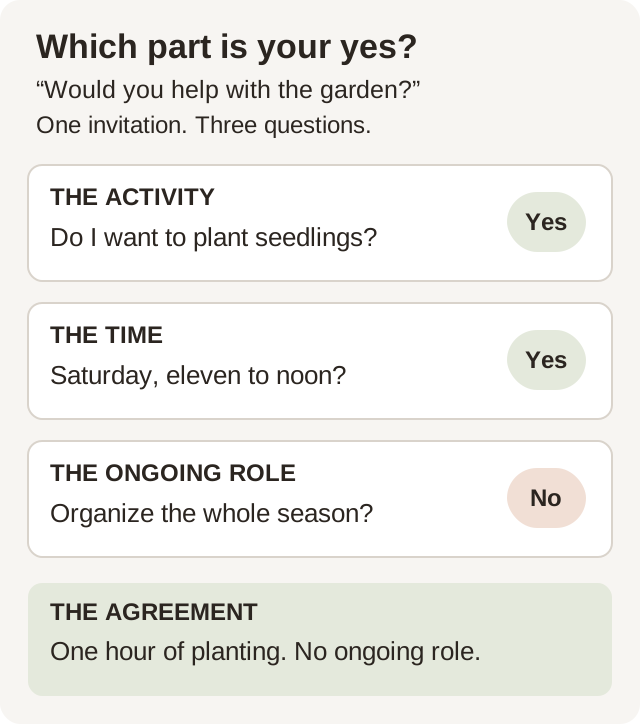
Imagine a neighbor asks you to help with a community garden. You like the
idea of planting things together. Then you learn that "help" includes
buying supplies, attending planning meetings, and covering a weekly shift.
The interest you noticed was real. So are the extra tasks. They deserve
their own answer.
An illustrative example: a clear agreement names the part, time, and limit. Interest in one activity does not answer every request attached to it.
Words you can use might be: "I'd like to help with planting. I can come
from eleven to noon on Saturday. I can't take on the supply orders or a
weekly shift. Would that still help?"
The other person may need someone who can do the whole role. In that
case, a smaller offer may not work. You can acknowledge that and leave the
invitation open or decline it.
Care responsibilities, an already full calendar, or a fixed budget do not
become less real because an activity appeals to you. Naming the limit
makes the agreement clearer for everyone involved.
What if your first yes changes later?
Compare the choice you first considered with the situation you face now.
The task may have grown, the timing may have moved, or you may have learned
something new. A changed answer deserves a practical conversation about
the agreement. It does not require a verdict about whether your original
response was the correct one.
Start with what changed. "I agreed to plant for an hour, and now I'm
being asked to coordinate deliveries" is easier to discuss than "My yes
was wrong." It gives both people something specific to work with.
Sometimes the request stays the same and your preference changes. You
can notice that too. Consider what you have already promised, who is
relying on it, and whether there is a workable way to adjust the plan.
Tell the other person early when you can.
The same approach helps with deadlines. Human Design's description of an
immediate response does not remove the need to check a calendar or read
the details. "I'm interested; I need to confirm the time" communicates
both pieces honestly.
If an answer is needed before you have every detail, name the part you
can responsibly agree to. For an optional activity, that may be no
commitment today. For an existing responsibility, it may mean discussing
how to meet it within the time and help available.
The point is an agreement you understand and can communicate. You do not
need to defend it with a chart label.
What is one small way to try this in everyday life?
Choose one optional activity with little cost and an easy way to change
course. Write down the precise question, what you notice, and the terms
you actually agree to. Afterward, compare those notes with what happened.
The purpose is to understand this choice more clearly, without turning
one experience into a rule for your life.
For a fictional example, Nina is invited to help at the garden. She
writes this before replying:
Note
Nina's example
The question
"Do I want to plant seedlings this Saturday from eleven to noon?"
What I notice
"I like the idea of being outside and doing the planting."
The practical check
"I can get there after my morning errand. I need to leave at noon."
The agreement
"One hour of planting, with no ongoing organizing role."
On Saturday, Nina enjoys the planting. The organizer asks whether she
can stay for lunch. She declines because she needs to leave. Her answer
to lunch does not undo her interest in the planting.
Later, her note is simple: "I enjoyed that hour. Having a clear finish
time helped me keep the rest of my day."
Your note might say something different: "I expected to enjoy it and
didn't," or "The question didn't change how I decided." Those are useful
observations too. Record the experience without scoring how well you
performed your Human Design.
For your next small choice, you only need three lines: the question, the
agreement, and what happened. Keep any distinction that made the choice
easier to understand.
How does this fit into a personal reading?
A personal reading puts Human Design's teaching beside the life you
describe. Pattern Atlas uses your chart for the teaching and your quiz
answers for the facts about you. Together, they give context for one small
step that fits your actual situation, including the limits you need to
work within.
The chart describes, in Human Design's terms, how you were born to work
and decide. Your answers describe how you live now: what you want, what
others expect, and what your days allow. The two may pull apart, or you
may already have a way of deciding that works well.
The free summary places those accounts side by side and shows your
book's contents and page one. The complete reading is a PDF book built
from carefully written passages, chosen for your answers. It includes
practical tools, words you can use, and one small step to try. Our
methods and sources explain how the pieces contribute.
For the next invitation you receive, start with the details: what would
you do, when, and for how long? That gives your answer something clear
to refer to, whether it is yes, no, or a request to know more.
Do all Generators and Manifesting Generators have sacral authority?
No. In Human Design, both types can have sacral or emotional authority. A defined Solar Plexus center gives emotional authority priority. Read the authority field on your chart rather than inferring it from your type. If your birth time leaves that field uncertain, keep the uncertainty visible.
Does a sacral response have to be a sound?
Human Design describes both sounds and bodily sensations, often using 'uh-huh' and 'uh-uh' as examples. You do not need to perform a particular sound. Write down what you actually notice, including a plain preference or no clear response, without making your experience fit the description.
Does an unclear response mean no?
An unclear response tells you that you have not noticed a clear answer. You can check what is missing: the task, time, cost, or other details. You can still decline an optional request without claiming that uncertainty proves a permanent no.
Should I sleep on a decision if I have sacral authority?
Human Design describes sacral authority as responding in the moment and emotional authority as finding clarity over time. An immediate response still leaves room to check facts before making a commitment. You can ask for time to confirm the details, regardless of your chart.
What if I said yes and now feel differently?
Compare the original agreement with what is being asked now. The task, timing, or your circumstances may have changed. Explain any change to your commitment clearly and consider who is relying on you. A changed preference does not need to become a verdict about whether you followed your chart correctly.
Pattern Atlas is a Human Design–inspired reflective self-discovery product, not a diagnostic tool.