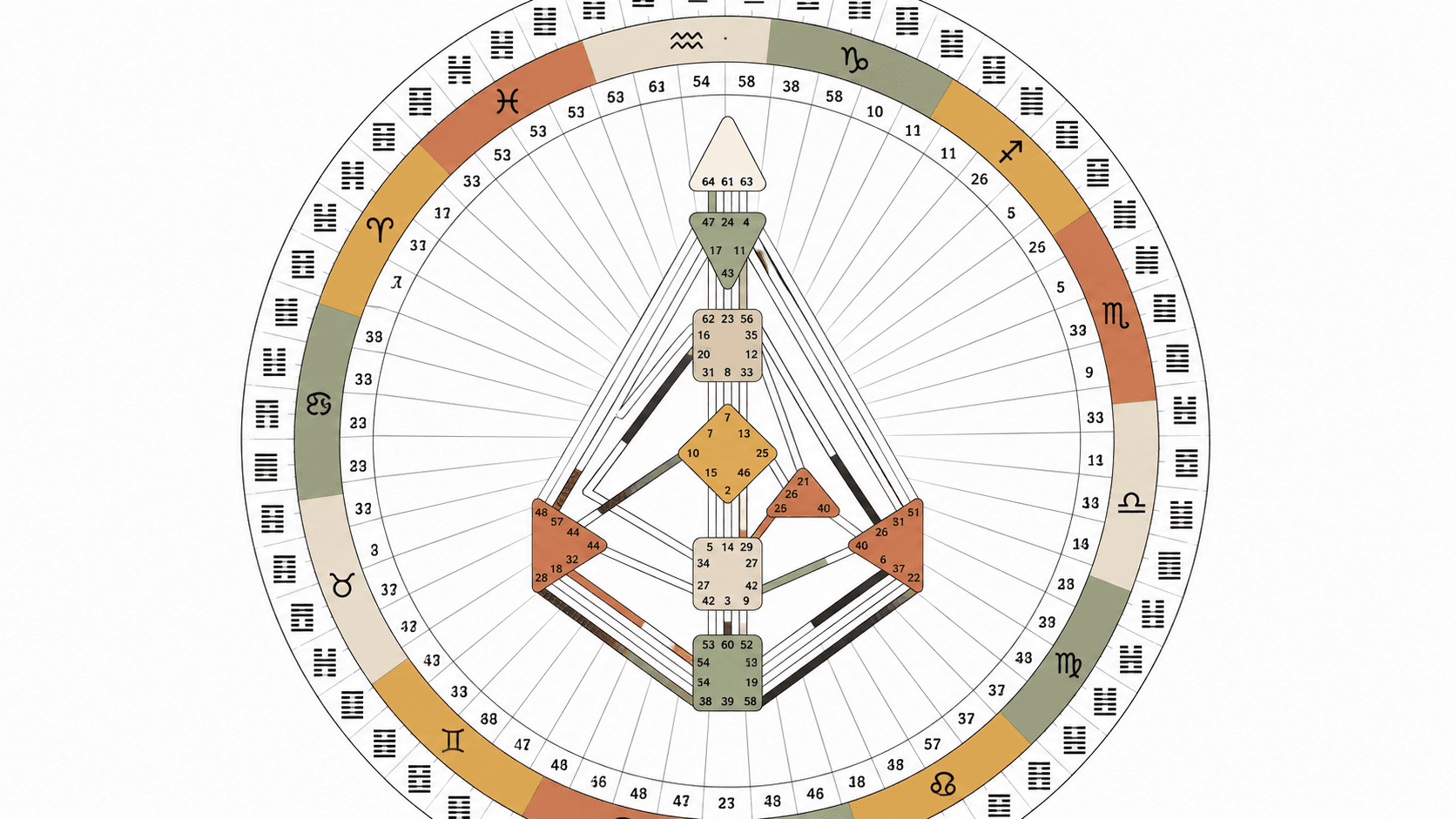
Jovian Archive is the official source of Human Design, founded on Ra Uru Hu's
original teachings, and its free MyBodyGraph chart is the reference implementation.
Modern tools trade some of that lineage for clearer language and faster explanation.
Which one suits you depends on whether you want orthodoxy or accessibility first.
What is Jovian Archive, and why does it matter?
Jovian Archive is the organization that stewards Human Design's source material —
the recordings, books, and courses of Ra Uru Hu, who developed the system in the
late 1980s. When practitioners argue about what Human Design "really" says, this is
the canon they point at.
That stewardship matters for one practical reason: terminology and mechanics. The
official material defines how types, centers, gates, and channels are calculated and
named. Any serious chart tool, including modern ones, ultimately implements the same
underlying mathematics; the differences live in presentation, explanation, and what
gets sold around the free chart.
What do you get from the official MyBodyGraph chart?
MyBodyGraph, Jovian Archive's chart service, generates a free bodygraph from your
birth details: your type, strategy, authority, profile, definition, and the full map
of defined and open centers with gates and channels marked.
What you get is authoritative and complete. What you do not get for free is much
explanation — the free tier shows the chart and brief labels, while fuller analyses
and courses are paid products in the source tradition's own vocabulary. That
vocabulary is precise, but it assumes you are willing to learn a new language:
sacral response, not-self theme, hexagram lines.
For people who want to study Human Design as a system, starting at the source is a
defensible choice, and this article would be poorer if it pretended otherwise.
How do modern chart tools differ?
Modern tools — ours included — implement the same chart mathematics and
then spend their effort on translation. Instead of assuming you will learn the
terminology, they explain each element in plain language as it appears: what a
Generator's response actually feels like on a Tuesday, why
an emotional authority should sleep on big decisions.
| Official chart (MyBodyGraph) | Modern explainer-first tools |
|---|
| Cost of the chart | Free | Free |
| Language | Source terminology | Plain language |
| Explanation depth (free tier) | Labels and basics | Guided explanations |
| Lineage fidelity | The canon itself | Interprets the canon |
| Honest-uncertainty handling | Varies | Should be explicit |
Two things are worth checking in any modern tool. First, calculation consistency:
your type, profile, and defined centers should match the official chart — if they
do not, the tool has a mathematics problem, not a style difference. Second, honesty
about birth-time sensitivity: profile and authority can flip across a day, and a
trustworthy tool tells you so instead of projecting false confidence.
What does Jovian Archive sell beyond the free chart?
The free bodygraph is the doorway to a catalog: recorded lectures, books, and a
tiered education path from beginner courses to professional analyst training, plus
paid chart analyses produced in the source tradition's terminology. If Human Design
becomes a serious study for you, that catalog is where the deep material lives, and
no modern tool replaces it.
For a first-time chart owner, though, the sequencing matters more than the catalog.
Courses teach the system; they do not, by themselves, teach you about you. A
sensible order is chart first, plain-language explanation second, lived
experimentation third — and formal study only if the first three keep rewarding
attention. Money spent on lectures before you have tested your own strategy for a
month tends to buy vocabulary rather than insight.
Which chart numbers should agree everywhere?
Run your birth data through both kinds of tool and compare. Type, definition,
profile, and the pattern of defined centers derive from planetary positions and
should agree. If your birth time is approximate, expect honest tools to converge on
the stable elements and diverge only in how loudly they warn you about the rest.
Where tools legitimately differ is interpretation: how much they explain, what they
emphasize, and how carefully they separate reflection from prediction. That is a
values difference, not an accuracy difference — and it is where you should actually
choose.
So where should you get your chart?
Get it from both; they are free. Generate the official chart to anchor the raw
mechanics, and a plain-language chart to understand what those mechanics might mean
for your ordinary week. Where they agree — which should be everywhere that counts —
you can trust the mechanics. Where the explanations differ in tone, prefer whichever
treats you as the final authority on your own life.
If you start with ours, the free chart takes about a minute, explains each
element as it reveals it, and links every concept to a reference page you
can check independently. If you start with the source, you will meet the system in
its own words. Both roads lead to the same bodygraph.