Explore multiple interests through Human Design's Manifesting Generator teaching. Choose what gets time now, pause unfinished projects, and keep promises clear.
You can have several interests and still give one project your
attention today. If Human Design calls you a Manifesting Generator,
its teaching about response offers one way to explore those choices.
A practical starting point is to separate what interests you, what
you have promised, and what can wait.
What does Human Design say about Manifesting Generators?
Human Design describes Manifesting Generators as part of the Generator
family, with the ability to move quickly after responding. Responding
means meeting something concrete: a question, an opportunity, or an
activity in front of you. The emphasis is on what you respond to,
rather than maintaining a particular number of interests.
Human Design is a symbolic framework, not a scientifically validated
account of your abilities. A chart cannot establish that you are
better at multitasking or that every new interest deserves a commitment.
Perhaps you enjoy cooking, photography, and learning a language.
Perhaps you want to spend years getting better at one craft.
Neither preference needs to become a performance of your type.
The useful question is what you want to make room for now. You
might be glad to recognize yourself in a description of varied
interests. You can keep that recognition while looking closely at
the time, promises, and ordinary tasks each activity involves.
Do multiple interests mean you need to act on all of them?
An interest is something you want to explore. A commitment is
something you have agreed to give time or effort to. Keeping those
separate lets you enjoy an idea without immediately adding it to
your week. You can also put an existing project on pause while
keeping a clear way to return.
Try sorting a few activities by their current place in your life:
Where it stands
What that means
An ordinary example
Interested
You are curious; no work is promised
Saving the details of a pottery class
Committed
You have chosen a task or made an agreement
Sending three photographs to a friend on Friday
Paused
You are leaving the work for a later occasion
Keeping a draft with a note about the next section
Finished or released
The work has reached an ending you can name
Completing a short course without enrolling in another
An interest can stay an interest. Enjoying the idea of pottery does
not require buying equipment, enrolling this month, or becoming
someone who sells ceramics.
Likewise, choosing photography this weekend does not settle your
identity for the next ten years. It says where some of this weekend's
time will go.
You may notice an "I should" thought in either direction: "I should
pick one thing forever" or "I should make use of every interest."
Our article on Human Design conditioning
explores the system's teaching about picking up expectations. Here,
start by writing down the particular rule you feel expected to follow.
Then ask whether that rule describes what you actually want to do.
How do you choose what gets your time this week?
Begin with the week you have: existing promises, necessary tasks,
and whatever time remains. Then choose an activity specific enough
to try within that time. "Work on my photography" leaves many
decisions open. "Choose three pictures after lunch on Saturday" tells
you what you would actually be giving your attention to.
If you use Human Design for reflection, include authority, the
system's guidance for decisions. Manifesting Generators can have
Sacral or Emotional authority. Human Design associates Sacral
authority with an immediate gut response; Emotional authority calls
for time as feelings change. These distinctions appear in
Jovian Archive's authority guide.
That means the type name alone does not amount to "act on your first
feeling." Our Sacral authority article
looks more closely at the question a response is answering.
Alongside that reflection, check what the activity would require.
Does the class fit your budget? Is someone relying on you at that
time? Do you have the materials? Would you enjoy the task itself,
or mainly the idea of having completed it?
Money, health, care, and time remain real limits. A busy week may
have room for saving a class listing and nothing more. That still
leaves the interest available when you can consider it properly.
There is no ideal number of active projects supplied by your chart.
Choose a manageable arrangement and notice how it works in practice.
When does an unfinished project need a pause?
Look at why the work has stopped before deciding what to do with
it. You may still want the result but lack a clear next step,
need something from another person, or have less time than expected.
You may also have learned enough to decide that you no longer
want to continue.
"I haven't finished" describes a status. It leaves the reason open.
Try completing a more useful sentence: "The next part would be
easier to approach if I knew, had, or changed ___."
If the answer is "which photographs belong in the album," the next
task could be choosing one page's pictures. If it is "the dates
from my aunt," you may need to ask for those details and wait.
If it is "an evening I don't currently have," a pause may fit.
Notice whether you still want the result. Some worthwhile projects
include dull or difficult stages. Losing interest in one part does
not settle how you feel about the whole.
An ending is possible too. A beginner course may have taught you
what you wanted to know. A private draft may no longer matter to
you. You can keep what you learned and close it deliberately.
When other people are involved, the ending also needs a conversation
about what you agreed to do. A change in interest is information
to bring to that conversation.
How can you pause a project without losing your place?
Before you put the work away, leave a short note describing where
you stopped, the next visible action, and when you will look at
it again. Store the note with the work or link to its location.
Give your future self enough information to begin without having
to reconstruct the whole project.
There is a useful research idea behind making a specific plan.
In Masicampo and Baumeister's 2011 experiments,
participants who made specific plans for unfinished goals reported
fewer thoughts about those goals during an unrelated reading task
than participants who left them unplanned. The plans described how,
when, and where participants would act.
The note below is a practical adaptation of that idea. The studies
did not test this worksheet or Human Design types.
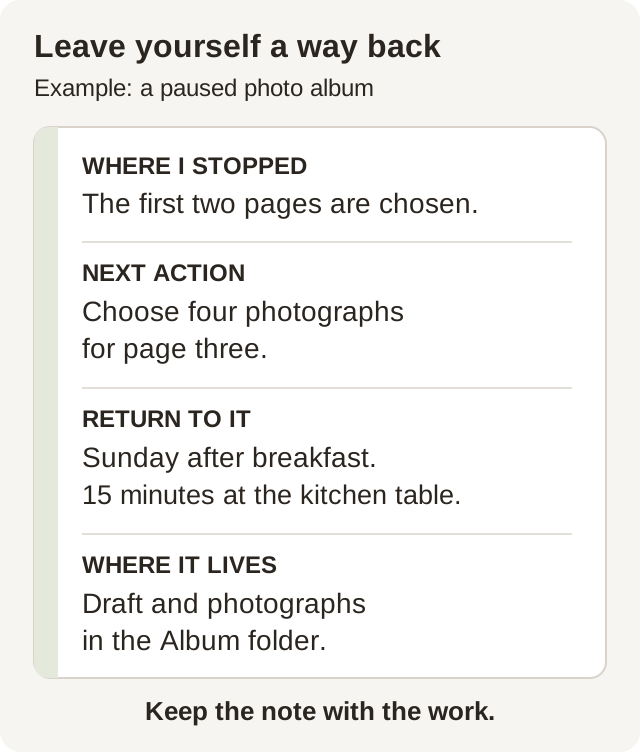
Illustrative example. A short note can record the work you have done and a concrete place to begin again.
Keep the next action small enough to recognize when you have done
it. "Finish the album" still contains many decisions. "Choose four
photographs for page three" gives you somewhere to start.
If another person's reply is needed, record that dependency. For
example: "Waiting for the dates; if I haven't heard by Friday,
send one follow-up message." You can leave the blocked part alone
while deciding what else, if anything, is useful to do.
A return date is an occasion to look at the work again. If your
circumstances have changed, update the plan. When you no longer
intend to continue, record that ending instead of repeatedly moving
an unwanted task into next week.
What if someone else is counting on you?
When a project includes a promise to someone else, tell them what
is changing while there is still room to discuss it. Name the
original agreement, what you can now offer, and what remains
undecided. Then hear their response. Your preference matters, and
so does the work another person has planned around your commitment.
You might still want to contribute but need a smaller role. You
might be able to finish one part and hand over the rest. Or the
original agreement may still be possible once the next step is clear.
Words you can use include:
To clarify: "I said I'd help with the album. Which part are you counting on me to finish?"
To propose a change: "I can choose the pictures by Friday. Could we move the layout to next week?"
To arrange a handover: "I've completed the first two pages. Can we agree who will take over the rest?"
The other person may need something different. A proposal becomes
a new agreement when you have both understood and accepted it.
Until then, keep the unfinished parts visible.
You can explain a change in ordinary terms: available time, the
work involved, or what you are willing to do. The conversation
does not depend on the other person knowing your Human Design type.
For future requests, it may help to promise a particular contribution
from the beginning. "I can choose the photographs" is easier for
both people to understand than "I'll sort the whole thing."
What could a small experiment look like?
Choose one unfinished project you control and one new interest you
would like to explore. Write down the existing project's next step
and a realistic occasion to return. Then decide whether there is
room to try the new activity. Afterward, notice whether the note
helped you resume and whether the new interest still appeals.
Here is a fictional example. Leila is making a photo album for
herself. She has chosen the first two pages, but the rest is a
loose collection of pictures. She also wants to try drawing with
the pencils she already owns.
Her usual thought is: "I can't start anything else until this is
finished." She decides to test a more specific arrangement for one
weekend. On Saturday, she spends twenty minutes drawing. Beforehand,
she leaves the album note shown above and puts it beside the draft.
On Sunday after breakfast, she opens the album folder at the kitchen
table and chooses four photographs for page three. She does not
finish the album that morning. She does complete the action she
had written down.
Her observations could be:
About the album: the note made it clear where to begin.
About drawing: she enjoyed trying it and wants another short session.
About her week: both activities fitted this weekend; next weekend may be different.
Your result might differ. You may find switching unhelpful and
prefer to finish the current project first. You may discover that
the new activity holds little interest once you try it. Keep the
observation that describes what happened, without forcing it to
match a type description.
How does this fit into a personal reading?
A personal reading connects Human Design's account of how you were
born to work with your description of life now. Several interests,
unfinished work, and pressure to choose one direction can mean
different things to different people. Your answers supply those
personal details, so the next step can fit the situation you actually face.
You might want more room for a hobby while keeping work that pays
the bills. You might want to finish something you care about.
You might already enjoy a mix of activities and want to protect it.
The chart does not choose among those stories for you.
Pattern Atlas starts with a free quiz. Your free summary puts your
answers and the chart's teaching side by side. The paid reading is
a PDF book built from carefully written passages, chosen for your
answers, with practical tools and one small step to try.
Our methods explain how Human Design, your answers, and
practical psychology each contribute. If a chart description clashes
with what you have observed, your experience takes priority.
For this week, the useful question can stay small: what would you
like to give time to, and what would help you return to the work
you still care about?
Does having multiple interests mean I am a Manifesting Generator?
Having several interests does not establish a Human Design type. The system calculates type from birth information. You can enjoy many activities, prefer one long project, or change your interests over time. Those preferences are useful observations about your life, whatever your chart says.
Are Manifesting Generators supposed to multitask?
A chart does not establish an ability to do several demanding tasks at once. Having multiple interests can mean enjoying different activities at different times. You can give one task your attention today and keep other projects available for another occasion.
Should a Manifesting Generator quit a project when it gets boring?
Boredom alone does not tell you whether to stop. Check whether you still want the result, whether the next step is unclear, and whether the work fits your available time. A chosen pause, a smaller next step, or an agreed ending may each fit a different situation.
Do all Manifesting Generators have Sacral authority?
No. Within Human Design, a Manifesting Generator can have Sacral or Emotional authority. Sacral authority emphasizes an immediate gut response; Emotional authority gives decisions time as feelings change. The type name alone does not tell you which guidance applies to your chart.
Does a Manifesting Generator need more than one career?
Your chart does not require several careers. Variety might come from different tasks within one role, a hobby, or occasional learning. Consider the actual work you enjoy and the conditions you need, including reliable income, available time, and care responsibilities.
Pattern Atlas is a Human Design–inspired reflective self-discovery product, not a diagnostic tool.