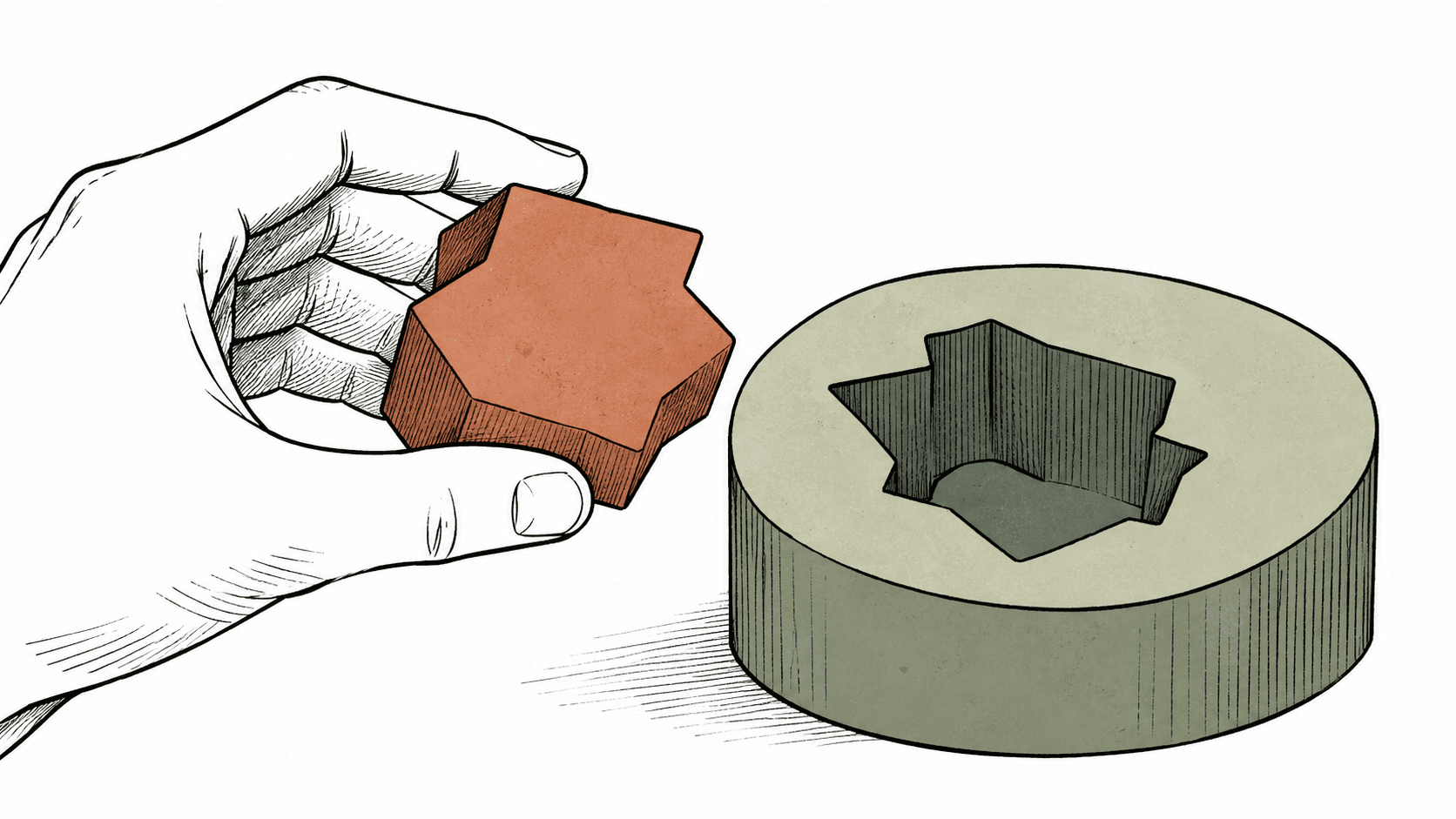
There is no universal right track. The honest question is whether the life
you're building fits the way you're wired. When it fits, ordinary weeks return
energy, decisions feel like yours, and you recognize yourself in your own days.
Feeling off track is usually a fit problem, not a failure.
What does "the right track" even mean when every track is different?
Most of the anxiety in this question comes from a hidden assumption: that
somewhere there is a correct track — a career arc, a relationship timeline, a
level of ambition — and your job is to find it and stay on it. That assumption
is what makes the question unanswerable. Measured against a universal standard,
almost everyone is behind someone.
Drop the assumption and the question becomes workable. A track is only right
for someone. The same steady job that gives one person a deep sense of
satisfaction leaves another person pacing by Thursday. The same freedom that
lets one person breathe makes another feel unmoored. Neither of them is failing;
they are differently wired, and their lives fit them differently.
So the honest version of the question is smaller and sharper: does the life you
are currently building fit the person who has to live it? Not "is this
impressive," not "would this hold up at a reunion" — does it fit. That question
has real answers, and you can gather evidence for it.
Why do you feel off track when nothing is wrong?
This is the tell that the checklist model of life is broken. You can have the
job, the relationship, the apartment — every box a reasonable person would
check — and still wake up with a low hum of this isn't quite mine. Nothing is
on fire, so there is nothing to point at, which makes the feeling harder to
take seriously, not easier.
The feeling usually marks a gap between two layers of you. One layer is your
baseline: how your energy, decisions, and sensitivities are naturally wired.
The other is the learned layer: the habits and standards life trained on top —
ways of choosing, working, and keeping the peace that were picked up to stay
safe or approved of. A life can satisfy the learned layer completely while
quietly pinching the baseline. From the outside it looks fine. From the inside
it costs energy every single day.
That is why "off track" so often shows up first as tiredness rather than
crisis. If that is how you notice it, start with
how energy type and authority describe the baseline;
it gives you the chart vocabulary behind that layer.
What does research say about goals that fit you?
The fit framing is not just a comforting reframe. It is informed by research on
self-concordant goals — goals aligned with a person's own interests and values
rather than absorbed from pressure or obligation. That line of research links
self-concordant goals to greater wellbeing and better follow-through: people
tend to sustain effort longer, and enjoy the result more, when the goal was
genuinely theirs to begin with.
Read plainly, that gives the "right track" question a working definition. A
goal reached on someone else's track pays out less than it cost. The same
effort spent on a goal that fits you compounds. The variable is not discipline
or luck; it is whose goal it was.
None of this hands you certainty about any particular choice. It simply says
the direction of the question is right: fit is not a luxury to sort out after
the achievements. It is the thing that decides what the achievements are worth
to you.
Which areas of life show you whether it fits?
Fit is not one global score; a life pinches in specific places. Six areas cover
most of them:
- Energy — do your weeks refill you or run you down, independent of workload?
- Decision — do choices feel like yours, or do you outsource and second-guess them?
- Boundary — can you say no without a three-day aftermath?
- Visibility — are you seen for what you actually do well, or for a role you perform?
- Worth — does your sense of value survive a quiet week without output?
- Belonging — do the people around you meet the real you or an edited version?
You do not need an instrument to walk through those six honestly, and doing it
on paper is a legitimate first pass. If you want the structured version, the
Alignment Readout scores these same six areas from your answers to map where
your life currently pinches — how it is scored, and its limits, are public.
Either way, the goal is the same: turn a vague sense of "off" into one named
area you can actually look at.
How do you actually check your own track?
Evidence beats rumination here. Four self-checks, each cheap:
Run the energy audit. For one ordinary week, note two moments a day: when
you felt most like yourself, and when you most wanted to be elsewhere. Patterns
appear fast, and they are usually about specific activities and people, not
about life in general.
Separate the voice. For any goal you are chasing, ask whose voice states
it. Some goals sound like you; others arrive pre-worded in a parent's, boss's,
or feed's phrasing. You are listening for goals you would still want if nobody
ever found out you reached them.
Check the Sunday signal. Dread on Sunday evening is data about Monday. Not
a verdict — a pointer to which of the six areas is carrying the pinch.
Name the decade default. Ask what your life looks like in ten years if you
change nothing. If the picture feels heavy, notice which part — that is the
area to examine, not proof the whole track is off.
If your version of "off track" is less about direction and more about the
paralysis of choosing, compare the
different decision-making authorities. The useful
question is what kind of clarity you are waiting for.
What should you do if you find a mismatch?
Resist the movie-trailer conclusion. Finding a pinch does not mean the life is
a mistake or that a dramatic exit is owed. Most mismatches are local: one area
under pressure, one commitment made by an older version of you, one standard
you absorbed and never audited. Local problems respond to local moves.
Treat whatever you found as a hypothesis, not a sentence. Design the smallest
reversible experiment that tests it: one boundary held for two weeks, one
scheduled block of the work that felt most like you, one honest conversation.
Small experiments generate real evidence, and real evidence is what eventually
makes bigger decisions feel less like leaps.
And if you want a structured starting map before you experiment, you can
compute your free chart — a Human Design–inspired mirror, not science
and not a fortune — and read up on
how the framework describes different wirings. Take all of it as
vocabulary for noticing, never as a verdict. The track is still yours to walk,
and yours to judge.