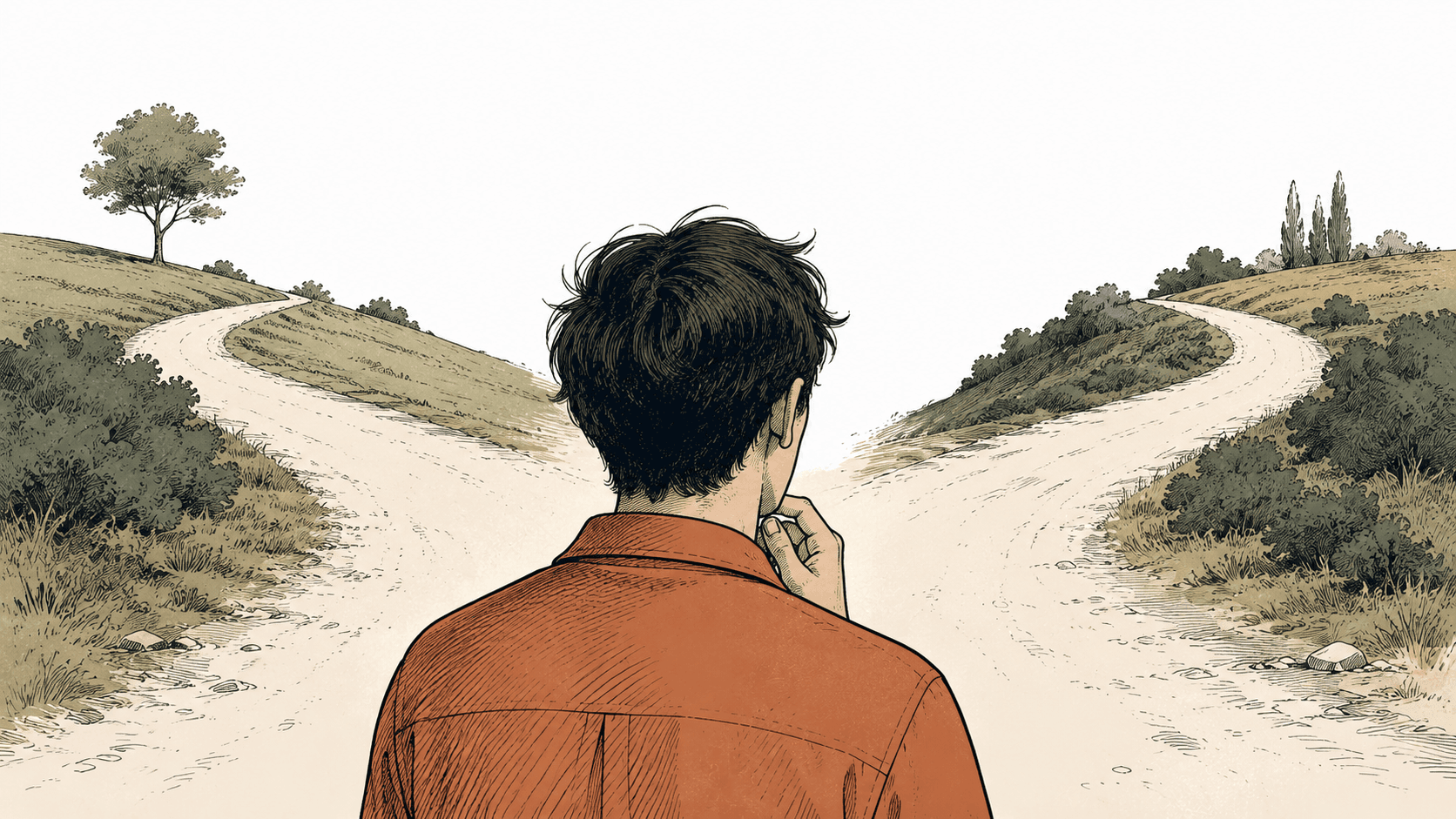
Chronic second-guessing is rarely a willpower problem. It usually means you are
deciding with a signal that was never yours — other people's logic, urgency, or
approval — while your own reliable signal goes unread. The fix is not more
confidence; it is learning which signal your decisions actually run on.
Why do you second-guess even small decisions?
Notice the texture of it. You decide, and the decision does not close. An hour
later the case reopens: maybe the other option, maybe you missed something,
maybe ask one more person. It happens with jobs and cities, but also with
sofas, replies, and lunch — which is the clue that this is not about the
stakes.
Second-guessing at that frequency is usually not indecision at all. It is what
happens when a decision gets made by the wrong authority. You ran the choice
through borrowed machinery — what a sensible person would pick, what would be
easiest to justify, what keeps everyone comfortable — and somewhere underneath,
your own signal either disagreed or was never consulted. The mind keeps
reopening the file because the real judge never ruled.
That reframe matters because it redirects all the effort. The problem is not
that you lack confidence in your decisions; it is that the decisions are not
yours to be confident in. No amount of self-trust exercises will make a
borrowed decision feel settled.
Why does asking for advice make it worse?
Because advice adds voices, and voices were the problem. Each opinion you
collect is one more version of the decision to hold, one more person to
disappoint by choosing otherwise, one more sensible-sounding frame between you
and your own reading. Three opinions in, you are no longer deciding about the
job — you are adjudicating between advisors.
There is a quieter cost too. Every time an outside answer overrules your inner
one and you comply, the inner signal learns it is not load-bearing, and it gets
harder to hear. Long-term second-guessers are often people whose signal was
overruled early and often — by families where someone else's certainty was
louder, by environments that rewarded the defensible choice over the true one.
That is learned, not innate. What was learned can be unlearned, which is
precisely the good news.
None of this means never ask anyone anything. It means advice works only
downstream of your own reading: gather input to inform the signal, not to
replace it.
How do different people actually decide well?
Here the most useful move is to abandon the idea of one correct decision
method. People appear to settle decisions through genuinely different signals
— and Human Design, which we use as an inspired lens rather than science,
offers one of the more testable vocabularies for the differences.
In its terms, some people get a quick gut response — energy that lifts toward
a yes or goes flat at a no, clearest in the first instant before thinking
kicks in: the Sacral pattern. Others run on an
emotional wave: the same choice looks thrilling in the morning and doubtful at
night, so real clarity only arrives after the wave settles — the
Emotional pattern, whose entire practice is
"sleep on it." Some get one quiet instinctive whisper that does not repeat.
Some only discover what they think by hearing themselves say it to a
good listener. And some need several
conversations in comfortable settings before the answer assembles at all.
You do not need to adopt the framework to see the practical point: if you are
a slow-clarity person using a decide-on-the-spot method, or a gut-first person
who deliberates until the signal is buried, you will second-guess constantly —
and it was never about willpower. It was a signal-method mismatch, which is
the kind of thing you can actually test.
What experiment finds your own signal?
Run this for two weeks, on small decisions only — where to eat, which task
first, whether to accept the invitation. Low stakes are the point: they are
frequent, and being wrong is free.
For each small decision, do three things. First, catch your immediate response
before any reasoning — write down one word for it. Second, note the method
that ends up actually deciding: gut, list, deadline, another person. Third,
the next day, score how the decision sat with you.
Two weeks of that produces a pattern you can trust more than any personality
description: which signal, when followed, produces decisions that stay closed
— and which method, when it overrules that signal, produces the reopened-case
feeling. Then promote the winning signal to bigger decisions gradually, one
reversible choice at a time.
If you want a head start on the hypothesis, your chart names a decision
pattern to test first — computing it is free — and the Alignment
Readout can show whether the Decision area is where your life currently
carries its pressure; the scoring is documented openly. Treat both
as hypotheses to check against your two weeks of evidence, never as verdicts.
Chronic second-guessing rarely travels alone — it is often one symptom of a
life running on borrowed standards, which is the larger territory mapped in
how to know if you're on the right track. But it
responds to something much smaller than a life overhaul: finding the signal
that was yours all along, and letting it rule on something as small as lunch.