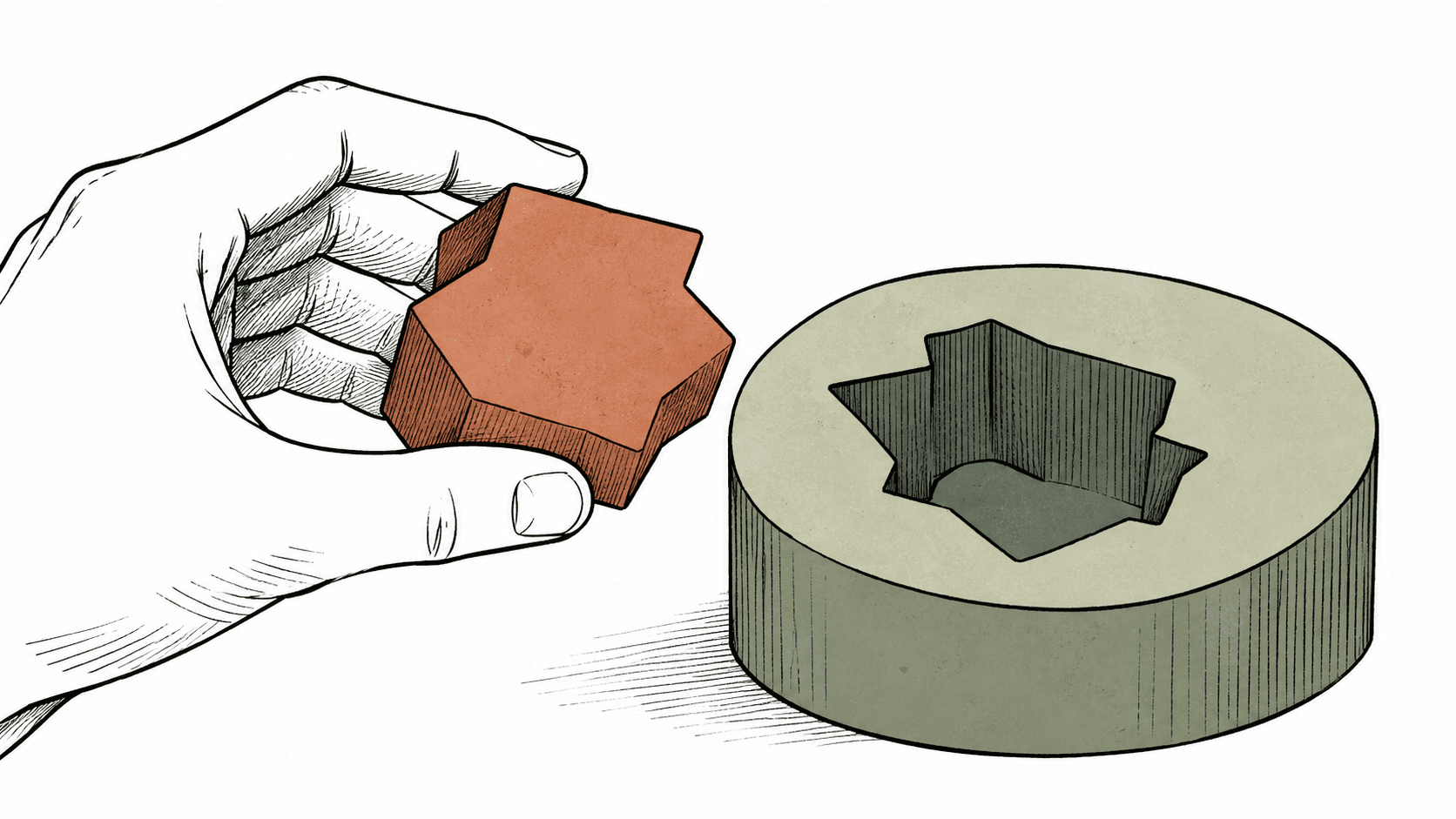
Generic advice fails you because it is written for an average person who does
not exist. Every rule that works for someone else was tuned to their wiring and
their history. Advice only lands when it knows which of your two layers it is
talking to — your baseline, or what life trained on top.
Why does advice that works for everyone else backfire on you?
You have probably run the experiment more than once. The morning routine that
rebuilt a friend's life left you exhausted by Wednesday. The "just commit and
momentum will follow" speech that unlocks some people locked you up further.
The boundary script that sounds so clean in a post came out of your mouth and
started a cold war.
The standard explanation is that you did it wrong, or gave up too early, or
secretly did not want it enough. Notice that this explanation protects the
advice and blames you — and that it is unfalsifiable, since any failure can
always be reframed as insufficient effort.
There is a simpler explanation. Advice is not a law of nature; it is a
compressed story about what worked for one kind of person in one kind of
situation. "Wake at five" works for people whose energy is steady and
front-loaded. "Trust your gut in the moment" works for people whose gut speaks
in the moment — and quietly sabotages people whose clarity arrives slowly,
after the feeling has moved through. The rule was never wrong. It was aimed at
someone else.
Is advice actually getting more generic?
The economics say yes. Producing advice used to cost something — a book took
years, a column took a week. Today the marginal cost of generating another
listicle, another routine, another "the one habit that changes everything" is
close to zero. When production is free, distribution decides what wins, and
distribution rewards whatever resonates with the widest possible audience.
Widest-possible-audience advice has a specific shape: it must be true-ish for
everyone, which means it is precisely true for no one. It sands off every
variable that makes advice land — your energy pattern, your decision style,
your history — because every variable it respects shrinks the audience.
To be clear, this is not an argument against technology, and it is not
AI-bashing. Computation is exactly what makes real personalization possible at
all — the same tools that can flood the world with averaged advice can also
calculate something for exactly one person. The dividing line is not human
versus machine. It is generic versus fitted: whether the advice knows anything
about you, or is guessing at an average and hoping you are near it.
Which layer of you is the advice talking to?
Here is the piece most advice cannot see, no matter how well written it is.
There are two layers to how you operate, and they need opposite treatment.
The first is your baseline — how your energy, decisions, and sensitivities
are naturally wired. This layer does not need improving. It needs to be worked
with: a person whose clarity comes slowly does not need a faster gut, they
need permission to sleep on things.
The second is the learned layer — the habits life trained on top of that
baseline. The reflexive yes, the overwork that once earned safety, the
peacekeeping that once kept a household calm. This layer is not you; it is
strategy you absorbed, and it can be updated once it is seen.
Now watch what generic advice does with those layers. "Push through the
resistance" is the right call when the resistance is a learned flinch — and
exactly wrong when the resistance is your baseline saying no. "Be kinder to
yourself, rest more" heals an overworked adaptation — and quietly becomes an
excuse when the real issue is a learned avoidance that wants company. The same
sentence is medicine for one layer and poison for the other, and one-size
advice has no way of knowing which one it is addressing in you. You can watch
this play out across a whole life in
how to know if you're on the right track — most
"off track" feelings are the two layers disagreeing.
What does advice that fits actually require?
Three things, and most content has none of them.
It starts from your data. Not your demographic — your specifics. How your
energy actually behaves across a week. How your decisions actually go right
and wrong. What your history actually trained you to do under pressure.
Fitted advice is downstream of a real picture of you; generic advice is
upstream of everyone.
It distinguishes the layers. It can say "this part of how you operate is
baseline — arrange life around it" and "this part is learned — here is where
it came from, and here is the experiment that loosens it." Without that
distinction, all advice collapses into either "change everything" or "accept
everything," and both are wrong half the time.
It hands you hypotheses, not verdicts. Anything that claims to know you
better than you know yourself has left honesty behind. The most a fitted
reading can do is say: here is the pattern the data suggests — check it
against your own weeks. That is how Pattern Atlas frames its own instrument,
the Alignment Readout, and the reasoning is laid out openly on the
methods page: informed by real research on the learned layer,
Human Design–inspired and honest about it on the baseline layer, and always a
mirror rather than a verdict.
How do you find advice with a sample size of one?
Start by auditing what you already consume. For any piece of advice, ask one
question before adopting it: who is this calibrated to, and am I that person?
Half the time the answer is obvious once the question is asked, and you can
stop paying rent on rules that were never yours.
Then build your own picture, because fitted advice needs something to fit.
Track your energy for a week. Write down how your last five good decisions
actually got made — not how you think decisions should get made. Note which
"shoulds" in your head arrive in someone else's voice.
If you want a structured mirror to start from, you can
compute your free chart — a Human Design–inspired map of the
baseline layer, offered as vocabulary for self-observation rather than as
measured fact. Whatever tools you use, keep the bar consistent: advice earns
its place by fitting your evidence, not by working for everyone else.